


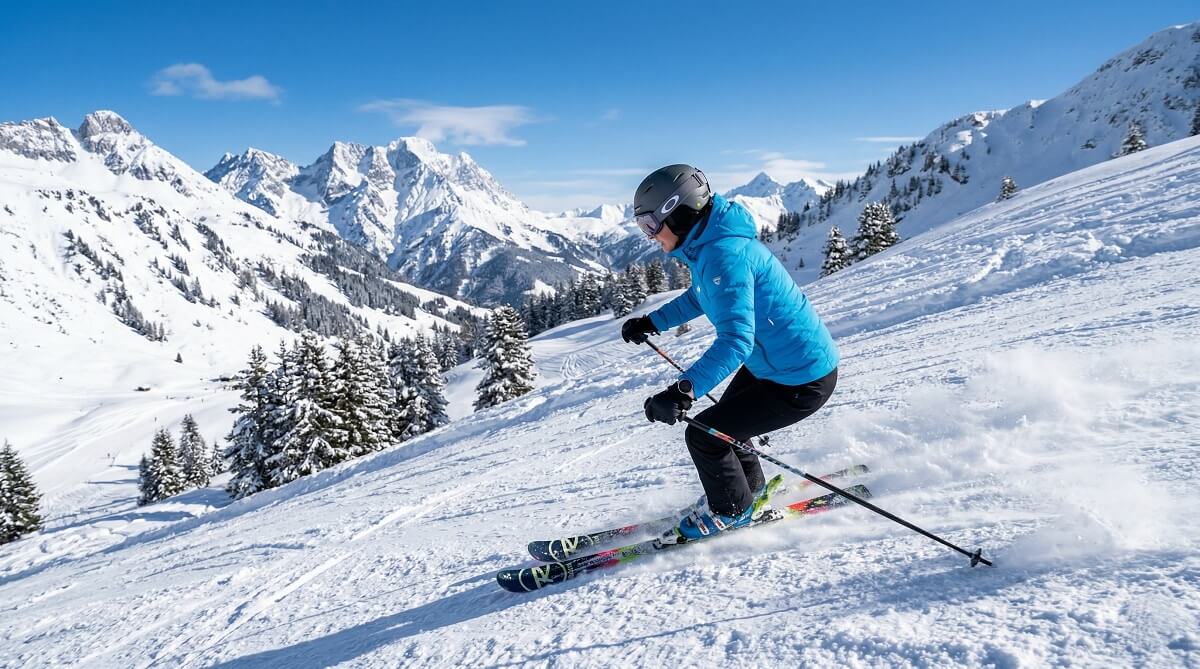
Downhill skiing burns roughly 360–504 calories per hour depending on your body weight, according to Harvard Medical School. A 125-pound skier burns around 360 calories per hour; a 185-pound skier burns closer to 504. Cross-country skiing burns significantly more — 396–586 calories per hour — because there’s no chairlift to rest on. You’re moving continuously the entire time.
A full ski day tells a more interesting story. A typical 6-hour outing includes roughly 3–4 hours of actual skiing (the rest goes to lifts, breaks, and a midday stop). For a 155-pound skier at moderate effort, that works out to somewhere between 1,300–1,700 calories burned from skiing alone — plenty to justify a post-ski meal, though probably not the whole après-ski spread.
The numbers shift substantially based on five factors: your body weight, skiing intensity, terrain type, temperature, and skill level. All five are covered below, along with a and tips on how to push the calorie count higher if that’s your goal.
Is Skiing the Right Workout for You?
✅ Skiing works well if:
- You want a low-impact cardio option that doesn’t punish your joints
- You ski regularly (three or more times per season) and want consistent fitness gains
- You’re looking for a workout you’ll actually want to do, not one you have to drag yourself to
- You want to build lower-body strength and core stability alongside your cardio
❌ Skiing isn’t your best bet if:
- You only get on the mountain once or twice a year — sporadic exercise doesn’t create lasting metabolic change
- You spend most of the day riding lifts and taking long breaks
- Your goal is maximum calorie burn per hour (running and HIIT beat skiing on that metric)
- You’re planning to eat significantly more during a ski vacation and hoping the two balance out automatically
How Many Calories Does Downhill Skiing Burn Per Hour?
According to Harvard Medical School’s calorie chart, here’s what downhill skiing burns per hour at three common body weights:
| Body Weight | Cal / 30 min | Cal / 60 min (approx.) |
|---|---|---|
| 125 lbs | 180 | ~360 |
| 155 lbs | 216 | ~432 |
| 185 lbs | 252 | ~504 |
These figures reflect standard alpine skiing at moderate intensity. If you’re pushing hard — carving aggressively, tackling steeps, hitting moguls — the burn climbs considerably. The Compendium of Physical Activities rates vigorous downhill skiing and racing at a MET value of 8.0, compared to 5.3 for moderate effort. That difference translates to roughly 50% more calories per hour for an all-out session versus a relaxed cruise.
One thing worth knowing: these numbers assume time spent actively skiing, not time sitting on the chairlift. Most fitness apps and smartwatches face the same limitation. A tracker running for six hours will record lift time as low-level activity — not the calorie burn of actual turns. If you want an honest count, look at your active skiing time separately.
How Many Calories Does Cross-Country Skiing Burn?
Cross-country skiing is a different animal. You don’t get a chairlift break. You’re moving uphill and across flat terrain under your own power, continuously, for as long as you’re out there. The calorie output reflects that.
| Body Weight | Cal / 30 min (XC) | Cal / 60 min (approx.) |
|---|---|---|
| 125 lbs | 198 | ~396 |
| 155 lbs | 246 | ~492 |
| 185 lbs | 293 | ~586 |
Source: Harvard Medical School
At a vigorous pace, cross-country skiing reaches a MET value of 9.0 or higher. Elite XC skiers are among the fittest athletes on the planet and regularly post some of the highest VO2 max scores ever recorded. You won’t hit those numbers in your first session, but even recreational XC skiing at a moderate pace burns more calories than most gym workouts of the same duration.
Ski touring and off-piste skiing fall into a similar range as XC on the calorie scale, since both require climbing effort that downhill skiing eliminates.
What Affects How Many Calories You Burn Skiing?
Body Weight
Weight is the single biggest variable. A heavier person moves more mass down the mountain, engages larger muscles to maintain control, and burns more calories doing the same run as a lighter person. The gap is significant: a 185-pound skier burns roughly 40% more calories per hour than a 125-pound skier at the same effort level. If you’re trying to estimate your own burn, use the MET formula: multiply your weight in kilograms by the MET value and then by 1.05 to get an approximate hourly calorie figure.
Intensity and Terrain
Groomed blue cruisers and mogul fields are not the same workout. Skiing moguls requires rapid, repeated knee flexion and extension, engaging your quads and core under constant load. Steep pitches demand eccentric strength — your muscles are fighting gravity to control speed on every turn. Aggressive, hard-charging skiing can burn 30–50% more calories per hour than a mellow groomer lap. If calorie output matters to you, the terrain choice matters too.
Skill Level: Beginners Actually Burn More Per Run
This surprises a lot of people. A beginner skier burns more calories per run than an experienced one, because the body has to work harder to achieve what the experienced skier does automatically. Learning to balance, stop, and control direction requires constant muscular engagement — stabilizers firing constantly, core bracing, ankles fighting to stay neutral in the boots. As your technique improves, movement becomes more efficient and the per-run caloric cost drops. That’s not a downside; it means you’re getting fitter. Experienced skiers compensate by skiing longer, faster, and on harder terrain.
Cold Weather and Altitude
Both add a small but real calorie premium. In cold air, your body burns extra energy maintaining core temperature — especially if you’re generating less body heat through slower skiing. Higher altitude means reduced oxygen availability, which pushes your cardiovascular system to work harder for the same output. Neither effect is dramatic (think 5–10% difference), but they do add up over a long day.
How Much Time You’re Actually Moving
Here’s the honest math: a six-hour ski day doesn’t mean six hours of calorie burn at skiing intensity. Factor in chairlift rides (largely passive), lunch, bathroom breaks, and standing around at the top of a run, and you’re probably looking at 3.5–4.5 hours of actual skiing movement. Calorie trackers that run the whole day will overcount if they don’t distinguish between active skiing and lift riding. A good GPS ski watch with auto-pause on lifts — like the — gives a much more accurate number.
How Skiing Compares to Other Workouts
If you’re wondering whether skiing pulls its weight against other activities, here’s a straightforward comparison for a 155-pound person over one hour. The calorie estimates below are based on MET values from the Compendium of Physical Activities — the standard reference exercise scientists use:
| Activity | MET Value | Cal/hr (155 lbs) |
|---|---|---|
| Cross-country skiing (vigorous) | 9.0 | ~662 |
| Running at 5 mph | 8.3 | ~610 |
| HIIT / circuit training | 8.0 | ~588 |
| Cycling at 12–14 mph | 8.0 | ~588 |
| Cross-country skiing (moderate) | 7.0 | ~515 |
| Downhill skiing (moderate) | 5.3 | ~432 |
| Snowboarding | 5.3 | ~432 |
| Brisk walking (3.5 mph) | 4.3 | ~317 |
Moderate downhill skiing lands in the middle of the pack — below running and cycling at comparable intensities, but well above walking and easy gym sessions. The real edge skiing has over those other options isn’t the per-hour calorie count. Consistency drives real fitness results, and skiing is one of the few winter activities that keeps people moving for six or more hours without it feeling like a chore.
Does Skiing Count as Cardio?
Yes — but the type of cardio depends on which version you’re doing.
Downhill skiing functions like interval training. Each run is a burst of sustained effort — your heart rate climbs as you navigate the slope — followed by a passive recovery period on the chairlift. This work-rest pattern is structurally similar to high-intensity interval training. Research published in Cell Metabolism (Robinson et al., 2017) found that exercise involving hard effort blocks separated by rest intervals was associated with improved fitness and longevity outcomes. Downhill skiing fits that pattern naturally, without you having to think about it.
Cross-country skiing, by contrast, is sustained aerobic cardio from start to finish. Your heart rate stays elevated throughout, making it more comparable to a long run or a rowing machine session. If you’re training specifically for cardiovascular endurance, XC skiing delivers a more consistent stimulus per session.
A 2016 study in the Journal of Sports Science and Medicine found that all types of skiing — downhill and cross-country included — offer measurable cardio-metabolic benefits: improved insulin resistance, better body composition, lower blood pressure and blood lipids, and reduced resting heart rate.
Is Skiing Good for Weight Loss?
Skiing burns real calories. Whether that translates to weight loss depends on what happens around the skiing.
The math works in your favor if you’re skiing regularly (three or more times per week during ski season) and keeping your eating roughly in line with your normal habits. A 155-pound person burning 432 calories per hour of downhill skiing, across a four-hour active ski day, racks up a 1,700-calorie deficit before accounting for anything else. That’s meaningful.
The complication: ski trips tend to come with increased eating. When your body works harder, it signals hunger. Cold weather amplifies that. And mountain food — heavier meals, warm drinks, après-ski — often runs calorie-dense. One estimate puts extra energy demands during a ski holiday at 1,000–1,500 additional calories per day just to keep up with the physical demands. That doesn’t mean you’ll automatically gain weight — it means you’ll need to be intentional if weight loss is the goal. (Source: Maison Sport, citing BUPA and Harvard nutrition data.)
How to Burn More Calories While Skiing
- Choose harder terrain. Moguls, steeps, and off-piste demand more muscular output than groomed blues. The harder the run, the higher the burn.
- Ski more, ride less. Lift time is passive. More runs = more calories. Skip the 20-minute break at the top if you’re there for fitness.
- Use your poles. Actively planting and pushing with poles adds upper-body engagement that adds to total output.
- Ski in colder conditions. A cold February day burns slightly more than a warm, slushy spring morning.
- Push your edges. If you’re an experienced skier, cruising familiar groomers won’t challenge your body much. Seek out terrain that actually requires effort.
What Muscles Does Skiing Work?
Downhill skiing is primarily a lower-body strength workout with a serious core demand. Here’s where the effort goes:
- Quadriceps — the primary muscle for absorbing impact and controlling descent. That burning thigh sensation after a hard run? That’s your quads working eccentrically under load.
- Glutes and hamstrings — hip stability, power transfer through turns, and keeping your hips low and centered.
- Core (abs and obliques) — rotation through turns, maintaining upright posture, and preventing over-rotation on variable terrain.
- Calves and ankles — balance inside ski boots, particularly in variable snow conditions.
For cross-country skiing, add the upper body:
- Shoulders and triceps — active pole push drives forward propulsion
- Back and lats — counterbalance during the push phase
The afterburn effect (excess post-exercise oxygen consumption) applies here: the more muscle groups recruited, the more calories your body continues to burn after you’ve finished for the day. A hard mogul session works more total muscle mass than most gym exercises, which means the calorie burn extends past the ski day itself.
Does Skiing Burn More Calories Than Snowboarding?
They’re essentially equal. The Compendium of Physical Activities assigns both activities the same MET value (5.3 at moderate intensity). According to Hone Health, Snowsports Industries America estimates skiing at around 500 calories per hour and snowboarding at roughly 450 — a modest gap that disappears once you account for individual variation in effort and weight.
The muscles engaged differ slightly: skiing demands more quad endurance for the bent-knee stance, while snowboarding emphasizes lateral core rotation. Neither has a meaningful edge on the other for calorie burn at comparable effort. Pick the one you enjoy more — you’ll ski or snowboard longer, and time on the mountain beats sport selection for total output.
Frequently Asked Questions
How many calories does skiing burn in a full day?
On a typical 6-hour ski day with roughly 4 hours of actual skiing (the rest goes to lifts and breaks), a 155-pound skier at moderate effort burns approximately 1,700–1,800 calories from skiing alone. A larger, more aggressive skier can push that figure past 2,200.
Does skiing burn belly fat?
Skiing burns calories from fat stores throughout your body — you can’t direct fat loss to a specific area. But consistent skiing combined with a calorie deficit will reduce overall body fat, which includes the midsection. Pair skiing with reasonable eating habits and it contributes meaningfully to fat loss over a ski season.
How many calories does an hour of skiing burn for a 200-pound person?
Using MET-based calculations, a 200-pound skier at moderate downhill intensity burns approximately 500–520 calories per hour. At vigorous intensity or on challenging terrain, that can climb to 750+ calories per hour. Cross-country skiing at the same weight burns roughly 670–870 calories per hour depending on pace.
Is skiing better cardio than running?
Running at 5 mph burns slightly more calories per hour than moderate downhill skiing for most people. However, cross-country skiing at a vigorous pace can match or exceed running. The practical advantage of skiing is duration — most people ski for 4–6 hours in a session, far longer than they’d run, which means total daily output often surpasses what a typical run provides.
Do beginners burn more calories skiing than experts?
Per run, yes. A beginner works harder to accomplish what an experienced skier does automatically — stabilizing balance, managing speed, controlling turns — which means more muscles firing constantly. Skilled skiers compensate by skiing harder terrain for longer periods, which ultimately evens things out or reverses them.
What fitness tracker is best for measuring skiing calories?
Heart-rate-based GPS trackers give the most accurate skiing calorie data. The Garmin Instinct 3 and Garmin Fenix 8 both feature auto-pause during chairlift rides and dedicated ski/board modes that record run-by-run data. The Apple Watch Ultra 3 is a strong alternative with solid workout tracking, though Garmin tends to offer better battery life for full ski days, as tested by Tom’s Guide in their head-to-head snowboarding comparison. See for full comparisons.
Can I lose weight skiing?
Yes, with two conditions: you’re skiing consistently (not just once a year), and you’re not dramatically increasing your caloric intake to compensate. Ski holidays are notorious for heavy eating and drinking. Use skiing as part of a regular winter fitness routine and keep meals reasonable, and the calorie math works in your favor.
How does skiing compare to the gym for fitness?
A hard day of skiing — particularly on challenging terrain — rivals a gym session for total calorie burn and muscle engagement. The difference is that skiing also develops balance, proprioception, and coordination in ways that gym machines don’t replicate. For lower-body strength specifically, skiing (especially moguls and steep terrain) provides a sustained workout that most gym-goers would find surprisingly demanding.
Want accurate calorie data from your next ski day? A heart-rate GPS watch pays off quickly for anyone who skis regularly. to find a model that handles cold weather, long battery life, and dedicated ski modes. Most major options now include auto-pause on lifts and run-by-run stats. Check current prices on Amazon or compare at .
