


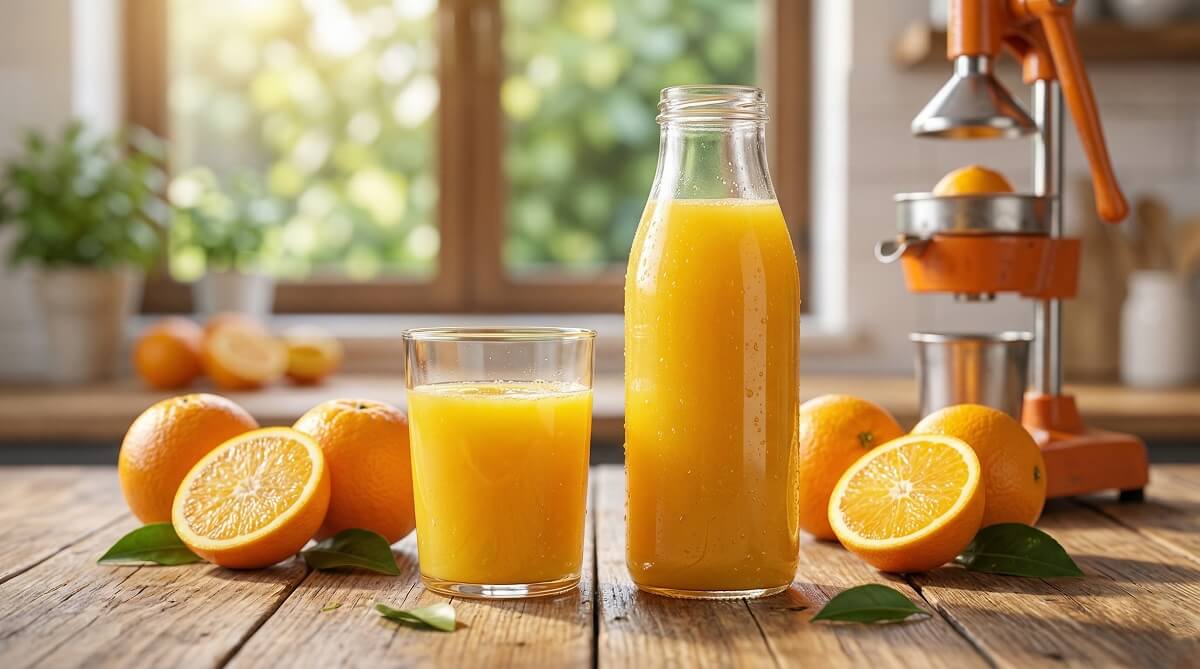
Cold-pressed orange juice is made by slowly crushing oranges with a hydraulic press — no spinning blades, no heat from friction — which means the juice retains more of its natural vitamins and enzymes. The result is a brighter, fresher-tasting product than what you’d find in a standard carton at the grocery store. You’ll pay for it, though: a single bottle typically runs $5–$8 at retail, compared to well under $1 per serving for a mainstream pasteurized carton.
The nutritional edge is real but modest. Fresh-squeezed and cold-pressed OJ retains roughly 15% more vitamin C and about 27% more folate compared to commercially pasteurized orange juice, according to research comparing the two. One 8-ounce serving of cold-pressed OJ delivers approximately 124mg of vitamin C — well above the daily recommended amount for most adults. If you want maximum nutrient retention from a juice, cold-pressed is the better option. But if you’re drinking OJ every morning and watching your budget, a quality pasteurized juice gets the job done.
ChubbytIps covers everything from how to pick the right equipment to getting the most out of your fresh ingredients. Below, we break down exactly how cold-pressing works, compare the top brands you can buy right now, and walk through how to make it at home.
Worth Buying — or Not?
✅ Cold-pressed OJ makes sense if:
- You want maximum vitamin and enzyme retention from your juice
- You treat juice as an occasional health boost rather than a daily staple
- You’re buying for post-workout recovery or during illness and want the most from each serving
- You enjoy the noticeably brighter, fresher flavor of minimally processed juice
❌ Skip it if:
- You pour a glass every morning — the cost adds up fast at $5–$8 per bottle
- You’re giving it to kids who won’t notice the difference
- You’re using it in cooking, baking, or cocktails where the nuance is lost
- Your first priority is fiber — eating a whole orange beats any juice, every time
What Is Cold-Pressed Orange Juice?
Cold-pressed juice uses a hydraulic press — sometimes called a slow press or masticating press — to extract liquid from fruit in two stages. First, the oranges are ground or shredded into a wet pulp. Then that pulp is placed into a filter bag or cloth and pressed between two plates under thousands of pounds of hydraulic pressure, squeezing out every drop of juice.
The key difference from regular juicing is the absence of spinning blades. Standard centrifugal juicers use a fast-spinning disc (often 3,000–15,000 RPM) to shred and spin juice out of fruit. That friction generates heat, which accelerates oxidation and starts breaking down vitamins like ascorbic acid (vitamin C) almost immediately. Cold presses run at much lower speeds and apply force without the heat, preserving more of the juice’s natural chemistry.
Cold-Pressed vs. Centrifugal vs. Pasteurized OJ — Key Differences
| Feature | Cold-Pressed OJ | Centrifugal / Fresh-Squeezed | Regular Pasteurized OJ |
|---|---|---|---|
| Process | Hydraulic press, no heat | Spinning blades, minimal heat | Centrifugal + heat pasteurization |
| Vitamin C retention | Highest (minimal processing) | High (if consumed quickly) | Lower (~15% less than fresh) |
| Shelf life (refrigerated) | 3–5 days (raw) / 30–60 days (HPP) | 2–3 days | 2–3 weeks (opened); months (sealed) |
| Fiber | Very low (juice only) | Low | Very low |
| Typical price per serving | $3–$7+ | $1–$3 (juice bar) or DIY | $0.50–$1.50 |
| Flavor | Bright, vibrant, fresh | Fresh but oxidizes quickly | Flat to cooked taste (from heat) |
What About HPP — High-Pressure Processing?
Many bottled cold-pressed juices you find at Whole Foods or on Amazon aren’t truly raw. They’ve gone through HPP — High-Pressure Processing — which uses water pressure of up to 87,000 psi to kill 99.999% of pathogens without applying heat. This extends the shelf life from 3–5 days to 30–60 days while preserving much of the nutritional profile that heat pasteurization would destroy.
HPP juice sits between raw cold-pressed and standard pasteurized on every scale: better nutrient retention than heat-pasteurized, slightly less than truly raw, and a dramatically longer shelf life than either. Most major brands — Evolution Fresh, Pressed Juicery, and others — use HPP. According to GoodNature’s breakdown of HPP juice, the label will usually read “high-pressure processing” or “cold-pressure processed” — look for it before assuming your purchase is raw.
What’s Actually in Cold-Pressed Orange Juice?
A standard 8 oz serving of orange juice — cold-pressed or otherwise — delivers approximately 124mg of vitamin C, which comfortably exceeds the daily recommended intake of 65–90mg for most adults. Pressed Juicery’s 16 oz bottle, for example, provides 190% of your daily vitamin C along with 860mg of potassium per bottle (about 430mg per 8 oz serving).
The practical difference between cold-pressed and pasteurized OJ comes down to what survives processing. A 2024 study in the International Journal of Food Sciences and Nutrition found that fresh-squeezed orange juice retained about 33% more vitamin C than commercial OJ at the end of its shelf life. Cold-pressed OJ also retains naturally occurring enzymes that heat destroys — though whether those enzymes survive digestion and provide meaningful benefit is still debated among dietitians.
A Word on Sugar
One thing cold-pressing doesn’t change: the natural sugar content. A 16 oz bottle of cold-pressed OJ from Pressed Juicery contains 36 grams of total sugars. That’s all from the fruit — no added sugar — but it’s still worth knowing. for more guidance on how to factor sugar content into your daily nutrition. If sugar is a concern, eating a whole orange (roughly 12g sugar, plus 2.4g of fiber to slow absorption) is always the smarter option.
Where to Buy Cold-Pressed Orange Juice in the USA
In Stores
The easiest places to find cold-pressed OJ in most US cities:
- Whole Foods Market — carries Evolution Fresh and their own store-brand cold-pressed OJ; typically in the refrigerated produce/juice section
- Sprouts Farmers Market — good selection of cold-pressed and HPP juices
- Target — Evolution Fresh available in many locations
- Trader Joe’s — carries fresh-pressed citrus juices seasonally
- Local juice bars — the freshest option; typically raw (no HPP) and consumed same-day or within a few days
Online (USA)
Several brands ship cold-pressed OJ directly or sell through major online retailers:
- Pressed Juicery — ships nationwide; $6.95/bottle (16 oz) regular, $5.50 with VIP membership. Check current pricing at Pressed Juicery
- Little West — Los Angeles-based, small-batch cold-pressed; 12 oz bottles around $6.29–$7.50 depending on retailer. Available via third-party retailers including PlantX
- Evolution Fresh — available in 15.2 oz, 32 oz, and 59 oz sizes. Check current pricing on Amazon
- Whole Foods Market / Amazon Fresh — Whole Foods 365 store-brand cold-pressed orange juice available in 32 oz and 64 oz. Check current pricing on Amazon
Brand Comparison at a Glance
| Brand | Size | Approx. Price | Processing | Where to Buy |
|---|---|---|---|---|
| Pressed Juicery | 16 oz | $6.95 ($5.50 VIP) | Cold-pressed | pressed.com, nationwide |
| Evolution Fresh | 15.2–59 oz | Check current pricing | Cold-pressed + HPP | Whole Foods, Target, Amazon |
| Little West | 12 oz | ~$6.29–$7.50 | Cold-pressed (small batch) | PlantX, local retailers, direct |
| Whole Foods 365 | 32–64 oz | Check current pricing | Cold-pressed + HPP | Whole Foods stores, Amazon |
| Natalie’s Orchid Island | 16–64 oz | ~$9.99 (56 oz, late 2024) | Fresh-squeezed (not hydraulic press) | Whole Foods, Amazon, Publix |
Prices reflect available data as of early 2026 — check current pricing before purchasing.
How to Make Cold-Pressed Orange Juice at Home
If you drink juice regularly, a masticating juicer is the single best investment you can make in your kitchen. It’s the consumer-grade equivalent of a commercial hydraulic press — running at low RPMs, generating minimal heat, and producing a noticeably cleaner, less foamy result than centrifugal machines. The upfront cost pays for itself within a few weeks compared to buying bottled cold-pressed juice.
What You Need
- Masticating juicer — budget models start around $100; higher-end options (Hurom, Omega, Kuvings) run $200–$400. for kitchen appliance recommendations
- Oranges — Valencia oranges are juicier; Navels are sweeter but yield less. Plan on 3–4 medium oranges per 8 oz serving
- A fine mesh strainer (optional) — for a pulp-free result
- Airtight glass container — for storage; consume within 3–5 days
Step-by-Step
- Choose oranges that feel heavy for their size — that’s the juice you’re after
- Peel them completely (or halve them if your juicer accepts citrus halves directly)
- Feed slowly through your masticating juicer at its lowest speed setting
- Strain through a fine mesh sieve if you prefer less pulp
- Pour into an airtight glass jar, seal, and refrigerate immediately. Drink within 3–5 days for best nutrition
What It Costs to Make at Home
A 5-pound bag of navel oranges averages around $4–$6 at most grocery stores. That bag yields roughly 10–14 medium oranges, which makes about 3–4 eight-ounce servings. At that math, your cost per serving sits around $1.00–$2.00 — far less than buying a bottle at $6–$8. The juicer pays for itself quickly if you make fresh juice a few times a week.
The trade-off is time: each batch takes 10–15 minutes to prep, juice, and clean up. For many people, that’s perfectly reasonable. For others, the convenience of pulling a bottle from the fridge wins out.
Is Cold-Pressed Orange Juice Actually Worth the Price?
For most people, occasionally. The nutritional edge over a quality pasteurized OJ is real but not dramatic — we’re talking about a 15–33% difference in certain vitamins, not a wholesale transformation of the product. If you already eat reasonably well, adding one $7 bottle of cold-pressed OJ to your week isn’t going to move the needle significantly on your overall nutrition.
if you’re interested in building smarter kitchen habits around whole foods. The honest answer from a nutrition standpoint is that eating whole oranges beats drinking any juice, cold-pressed or not. One medium orange has 2.4 grams of fiber that slows sugar absorption and makes the nutrients more bioavailable. Juice removes all of that.
That said, cold-pressed OJ does have a place: it’s a better grab-and-go option than a sugary sports drink or processed juice cocktail, it tastes noticeably fresher than anything that’s been sitting in a pasteurized carton, and for people who genuinely don’t eat enough fruit, it’s a meaningful nutritional boost. Buy it as a treat or occasional supplement — not as a daily substitute for actual fruit.
Frequently Asked Questions
How long does cold-pressed orange juice last?
Raw cold-pressed juice (no HPP) lasts 3–5 days in the refrigerator, sometimes up to 7 days if your produce was very fresh and stored below 41°F, according to GoodNature’s shelf life guide for cold-pressed juice. HPP-treated cold-pressed juice has a much longer window — typically 30–60 days when refrigerated and unopened. Once opened, drink HPP juice within 5–7 days.
Is cold-pressed orange juice pasteurized?
It depends on the brand. Truly raw cold-pressed juice is not pasteurized. Many commercial bottles (including Evolution Fresh and Pressed Juicery) use HPP — High-Pressure Processing — which kills pathogens without heat. HPP juice is not raw, but it’s not heat-pasteurized either. The distinction matters most for immunocompromised individuals, pregnant women, and young children, who should avoid raw, unpasteurized juices.
Does cold-pressed OJ have more vitamin C than regular OJ?
Generally, yes. Fresh and cold-pressed OJ retains roughly 15% more vitamin C and 27% more folate than commercially pasteurized juice, according to available research. A 2024 study found that fresh juice still had about 33% more vitamin C than commercial OJ even at the end of its shelf life. That said, both types deliver well above the daily recommended vitamin C intake per serving.
Can I freeze cold-pressed orange juice?
Yes. Pour into an airtight freezer-safe container leaving an inch of headspace, and it keeps for up to 3 months. Expect minor textural changes upon thawing — it’s still perfectly fine for smoothies or drinking straight. Some nutrient loss occurs with freezing, but it’s a reasonable option if you want to extend shelf life without HPP.
What’s the difference between cold-pressed and fresh-squeezed?
Fresh-squeezed typically refers to juice made with a centrifugal juicer or manual citrus press — both of which introduce some oxidation and heat. Cold-pressed specifically means a hydraulic press was used, which applies pressure without spinning friction. Cold-pressed juice generally oxidizes more slowly and retains a slightly brighter flavor and higher nutrient content than fresh-squeezed from a standard machine, though both beat commercial pasteurized OJ on freshness.
How many oranges go into one bottle of cold-pressed OJ?
A medium orange yields about 2–3 oz of juice, which means you need 3–4 oranges for a standard 8 oz serving. A 16 oz bottle (like Pressed Juicery’s) requires 6–8 oranges. This is one reason the price is so much higher than pasteurized OJ — there’s simply a lot of fruit in each bottle.
Is cold-pressed orange juice good for weight loss?
Not particularly. OJ is high in natural sugars (around 20–22g per 8 oz serving), and juicing removes the fiber from the fruit that would otherwise slow sugar absorption. A whole orange — 60–80 calories, ~12g sugar, 2.4g fiber — is a smarter choice for anyone managing weight. Cold-pressed OJ isn’t harmful, but calling it a weight loss tool would be overselling it.
Which brand of cold-pressed orange juice is the best?
For convenience and quality, Pressed Juicery and Evolution Fresh are the most widely available and consistently reviewed options in the USA. For small-batch freshness, Little West (California-made) is worth trying. For home production, investing $150–$300 in a masticating juicer and buying good Valencia oranges will beat any bottled product on freshness and cost per serving. for juicer recommendations.
Ready to Try Cold-Pressed Orange Juice?
Check current pricing and availability for popular brands:
- Evolution Fresh Organic Cold-Pressed OJ on Amazon
- Whole Foods 365 Cold-Pressed Orange Juice on Amazon
- Pressed Juicery — order direct
Or skip the bottle and to find the right masticating juicer for making it at home.
