


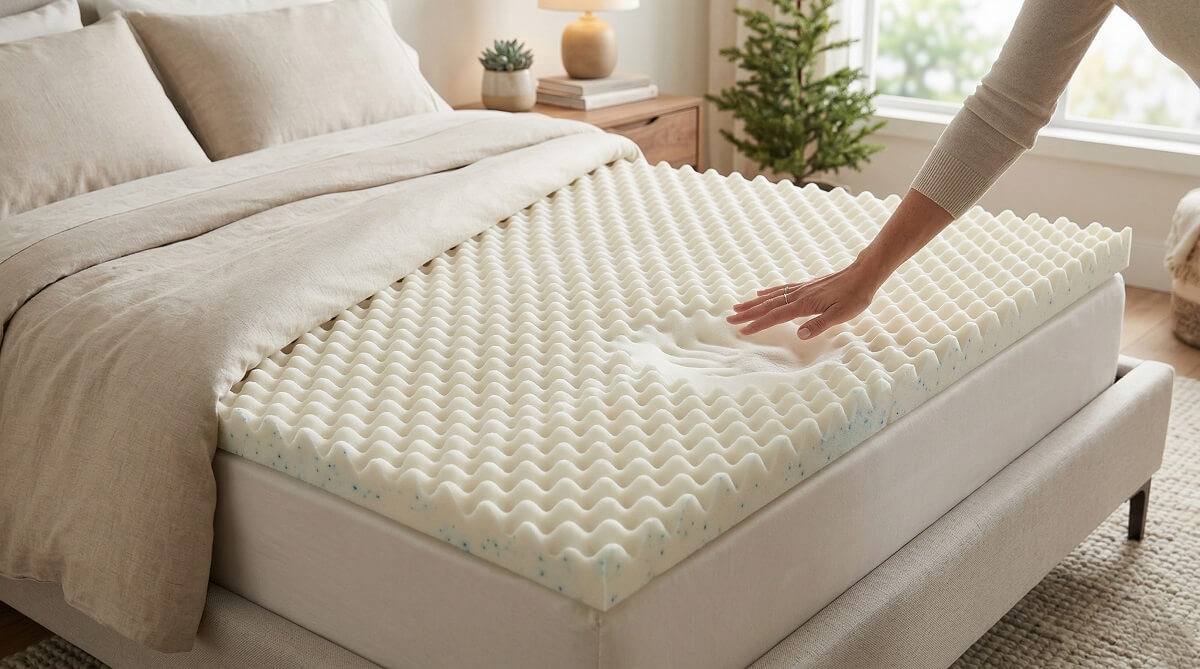
An egg crate king mattress topper puts a convoluted foam layer — peaks and valleys, like the bottom of an egg carton — between you and a hard mattress. That surface spreads your body weight, relieves pressure on your hips and shoulders, and keeps air moving underneath you in a way that flat pads can’t match. For most shoppers, it’s the cheapest meaningful upgrade before replacing a mattress outright. cover the full range of options if you’re still weighing a new bed versus a topper.
The right pick depends on two things: foam type and thickness. A 2.5-inch HD36-HQ poly topper from a direct seller runs about $54 for a king and holds up for everyday use. A memory foam convoluted version on Amazon costs around $90 and gives you slower, deeper contouring. Organic latex egg crate toppers run $89–$100 and last the longest. Below, you’ll find real prices, honest trade-offs, and a clear path to which foam is right for your situation.
Who Should (and Shouldn’t) Buy an Egg Crate King Mattress Topper
Best For
- Side sleepers whose hips and shoulders dig into a firm mattress
- Anyone waking up with pressure-point soreness who isn’t ready to purchase a new bed
- Hot sleepers who find flat foam pads trap too much heat
- Budget shoppers — a king topper starts under $35 for basic poly foam
- Guest rooms, RVs, or recovery use (egg crate foam has a long history in hospital beds for pressure sore prevention)
Skip If
- Your mattress sags or has body indentations — a topper won’t fix structural problems
- You’re a strict stomach sleeper who prefers a flat, firm surface
- You’re over 250 lbs and primarily back-sleep — you’ll likely compress lighter foam grades quickly and need a denser option
- Long-term durability is a priority — poly foam grades can flatten within a year or two of regular use
What Makes Egg Crate Foam Different From a Regular Pad
Standard foam pads are flat slabs. A convoluted topper is cut in a peak-and-valley pattern, so the surface isn’t solid contact. When you lie down, the peaks compress under heavier parts of your body (hips, shoulders, knees) while the valleys stay open. That does two things: it distributes your weight more evenly than a flat surface, and it creates air channels that keep heat from building up under you overnight.
often compare this design to memory foam. Memory foam contours slowly and hugs your body shape, which some people love and others find too warm or difficult to move on. Egg crate foam responds immediately — you shift positions and the foam pops back without resistance. If you run hot or move around a lot at night, that responsiveness matters.
Peaks Up or Peaks Down — Does It Matter?
Peaks up is the standard orientation and what most people should use. With peaks up, the convoluted surface cushions directly under you, and air flows through the gaps between peaks. Flip it peaks down if you want a flatter, slightly firmer feel — the peaks press into the mattress instead of your body, and the flat side faces up. Both work; it’s a personal call. Foam Factory’s product notes confirm the pad can be used either way.
The Medical Heritage Worth Knowing
Egg crate foam wasn’t invented for consumer mattresses. It has roots in hospital care, where convoluted foam pads have been used to help bedridden patients avoid pressure sores by reducing concentrated load on bony areas and improving air circulation. According to Sleep Junkie’s 2026 comparison, the foam is “recommended by doctors and wound care specialists to provide constant and uninterrupted air circulation underneath patients.” Consumer versions carry that same design principle into everyday sleep.
King Size Egg Crate Topper Dimensions — and What That Means for Your Sheets
A standard king egg crate mattress topper measures 76 inches wide by 80 inches long, matching a standard king mattress. California king is different: 72 inches wide by 84 inches long — narrower and longer. Per Foam Factory’s size chart, some CA king toppers are built as a 72″×80″ piece with a 4-inch section glued to one end. That’s fine structurally, but worth knowing if you’re particular about seamless construction.
Adding a topper gains you 1.5 to 3 inches of total mattress height depending on thickness. If your current fitted sheets are already stretched tight, you’ll likely need deep-pocket sheets with 15–18 inches of pocket depth to accommodate the extra height. Standard-pocket sheets (12 inches) will pop off the corners overnight with a 2.5-inch topper on a thicker mattress.
cover sheet compatibility in more detail if you’re setting up a full bed refresh.
Foam Types: Which Grade Should You Pick?
Foam grade is the biggest factor in how a convoluted topper performs over time. It shapes how it feels, how long it holds up, and what you’ll pay. Here’s the practical breakdown.
| Foam Type | Feel | Best For | Est. Lifespan | King Price (approx.) |
|---|---|---|---|---|
| Poly Foam | Soft, light | Guest rooms, occasional use | 1–2 years | $24–$35 |
| Super Soft Foam | Very plush | Light sleepers, extra cushion | 1–2 years | $32–$47 |
| HD36-HQ Foam | Balanced, medium | Everyday use, side/back sleepers | 3–5 years | $37–$54 |
| LUX-HQ Foam | Firm | Heavier sleepers, firm preference | 3–5 years | $39–$57 |
| Memory Foam (convoluted) | Contouring, slow-response | Deep pressure relief, cooler than flat MF | 3–4 years | $80–$110 |
| Organic Latex | Bouncy, responsive | Hot sleepers, natural material buyers | 5+ years | $89–$189 |
Pricing based on verified data from Foam Factory’s king-size price table (poly through LUX-HQ, March 2026) and current Amazon/Turmerry listings for memory foam and latex options. Prices shift, so check current listings before ordering.
A Note on ILD (Firmness Rating)
Foam firmness is measured in ILD — Indentation Load Deflection. It’s the pounds of force needed to compress foam by 25%. Lower ILD means softer (around ILD 10–20 for very soft foam); higher ILD means firmer (ILD 40–50+ for dense support foam). HD36-HQ sits in a medium range (roughly ILD 36), while LUX-HQ is firmer. Most people who’ve been sleeping on a too-hard mattress find the HD36 range comfortable without bottoming out.
Top Picks for Egg Crate King Mattress Toppers
cover a wider range of sleep surface options. Here are three solid egg crate king toppers at different price points.
Best Budget — Foam Factory HD36-HQ Egg Crate (2.5″, King)
Price: ~$53.99 direct from The Foam Factory (as of March 2026). Free shipping on orders over $100.
The HD36-HQ hits the sweet spot for most everyday sleepers — medium firmness, solid durability, made in the USA, and CertiPUR-US certified. The 2.5-inch version gives more cushioning than the 1.5-inch, and at under $55 for a king, it’s the most economical option for daily use. Verified buyers consistently report meaningful hip and shoulder pain relief within a few nights. Prefer a firmer feel? Step up to the LUX-HQ at $56.99.
Best on Amazon — SINWEEK 2″ Egg Crate Memory Foam (King)
Price: ~$89.99 on Amazon (as of March 2026, check for current price).
This is a memory foam version of the egg crate design — same convoluted surface, but memory foam slows the response and gives deeper contouring compared to standard poly. CertiPUR-US certified. A good pick if you want the convenience of Prime returns and prefer a more conforming feel than open-cell poly foam. Side sleepers with significant hip pressure may want to go with the 3-inch variant (~$79.98 king) rather than the 2-inch.
Best Organic — Turmerry Latex Egg Crate Topper (King / CA King)
Price: $89 on sale (regularly $189) at Turmerry for Cal King (as of March 2026). King pricing similar — verify the current site for exact king-size cost.
Turmerry’s convoluted topper is made from GOLS-certified organic Dunlop latex. Latex responds faster than memory foam, sleeps cooler than either poly or MF, and holds up significantly longer. The 5-year warranty and 120-night sleep trial are the best return policy in this category. If you’re buying for the long haul or want to avoid synthetic foam chemicals entirely, this one earns the step up. has more on organic sleep materials.
How to Set It Up and Keep It in Good Shape
Setup takes about five minutes. Unroll or unfold the topper on your mattress, peaks facing up (or down if you prefer a flatter surface — see above). A faint foam smell when you first open it is normal off-gassing; air it out for 24–48 hours before sleeping on it. Most buyers report no noticeable odor.
Put a mattress protector or topper cover over the egg crate pad, not underneath it. This keeps the sleep surface clean without trapping moisture between the topper and your mattress. for cover options that work well with thicker toppers.
Cleaning is spot-only — no washing machine. Egg crate foam, especially latex, is sensitive to heat and agitation. Dab spills with a damp cloth and mild soap, then let it air dry completely before covering. Replace the topper when it stops rebounding to its original loft or when flat spots appear. Poly foam grades: typically 1–2 years of regular use. HD36-HQ and latex: 3–5+ years.
Frequently Asked Questions
What size is a king egg crate mattress topper?
A standard king topper measures 76 inches wide by 80 inches long — the same footprint as a standard king mattress. California king is 72″ × 84″. Double-check the product listing before ordering, since a few sellers list CA king sizes under generic “king” labels.
Which side of the egg crate topper should face up?
Peaks up is the standard setup and what most sleepers prefer. The peaks compress under your body weight and the valleys create air channels. Peaks down (flat side up) gives a slightly firmer, flatter feel. Both orientations work — try peaks up first and flip it if the feel is too soft.
Do I need deep-pocket sheets with an egg crate topper?
Likely yes, especially with a 2.5-inch or thicker pad. Your total mattress height increases by the topper’s full loft. Look for fitted sheets with 15–18 inches of pocket depth to stay put overnight. Standard 12-inch pocket sheets will pop off corners on thicker setups.
How long does an egg crate king mattress topper last?
It depends on the foam grade. Basic poly foam: roughly 1–2 years with regular nightly use before noticeable compression. HD36-HQ and LUX-HQ polyfoam: 3–5 years. Organic latex toppers can last 5 or more years with proper care, per Turmerry’s product documentation.
Is egg crate foam good for back pain?
It helps many people, particularly those whose discomfort comes from pressure on bony areas (hips, shoulders, tailbone) while resting on a too-firm mattress. It’s not a fix for poor spinal alignment support. If your mattress sags or lacks foundational structure, a topper alone won’t resolve deeper lower back issues.
What is the difference between egg crate foam and memory foam?
The convoluted surface design is a construction style, not a material — you can get peak-and-valley toppers in poly foam, memory foam, or latex. Standard poly egg crate responds immediately and promotes airflow. Memory foam egg crate contours more deeply and responds slowly. Poly is more affordable and cooler; memory foam delivers deeper pressure cushioning at a warmer sleep temperature.
Can I wash an egg crate mattress topper?
No — machine washing will damage the foam structure. Spot clean only with a damp cloth and mild soap. Let it air dry fully before use. A removable, washable topper cover is the practical long-term solution for cleanliness.
Are egg crate mattress toppers CertiPUR-US certified?
Many are, but not all — confirm before purchasing. Foam Factory’s toppers and the SINWEEK memory foam topper carry CertiPUR-US certification. Turmerry’s latex toppers carry GOLS and OEKO-TEX certifications instead (latex has its own certification bodies). explain what each certification actually covers. If safety certification matters to you, verify it against the specific product listing.
Compare current pricing across your preferred option: Foam Factory direct has the lowest prices on poly foam grades, Amazon is the fastest option for memory foam picks, and Turmerry is worth a look if you want organic latex with a trial period. Prices shift seasonally, so it pays to check a few sources before you order.
