


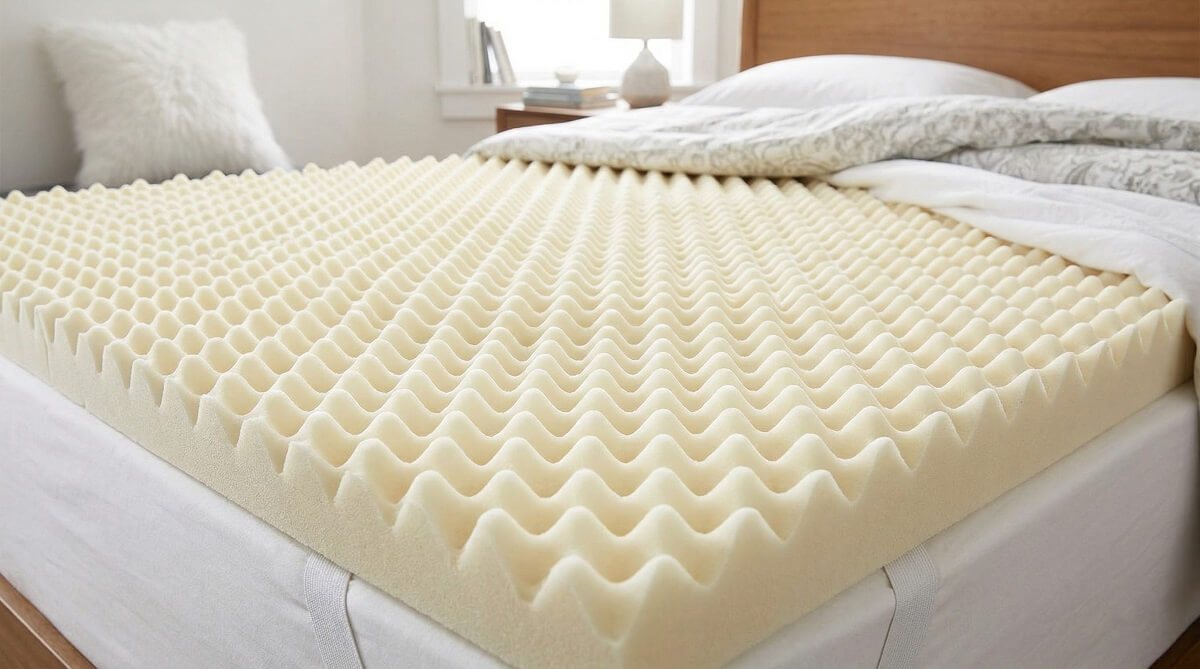
An egg crate topper is a foam pad cut into a repeating pattern of peaks and valleys — the same profile as the cardboard tray that holds a dozen eggs. That convoluted surface spreads your body weight across more contact points, reducing concentrated pressure at your hips and shoulders. It also creates channels that let air move beneath you while you sleep, which is why hospitals have used this style of pad for decades to help patients avoid pressure sores during extended bed rest.
For most people, an egg crate topper is a practical, low-cost fix for a bed that feels too firm or runs too hot. Entry-level polyurethane options run $25–$60 for a queen on Amazon. Premium organic latex versions — like the Turmerry Organic Egg Crate Latex Topper — start around $89 and hold up considerably longer. The right choice depends on how long you plan to use it and what your sleeping surface actually needs. for more context on mattress accessories.
One honest caveat up front: if your mattress already sags or has permanent body impressions, a topper is a short-term workaround, not a fix. The peaks will follow the contours of a worn mattress, not correct them.
Who Should (and Shouldn’t) Buy an Egg Crate Topper
✅ Best For
- Side sleepers who wake up sore at the hips or shoulders — the foam pockets reduce pressure at those contact points
- Hot sleepers on a firm mattress — air channels provide passive cooling that flat foam can’t match
- Anyone extending the life of a still-supportive but uncomfortably firm bed
- Hospital or recovery use — distributing pressure to reduce the risk of skin breakdown during extended bed rest
- Dorm rooms, guest beds, and RV mattresses where a low-cost, lightweight solution makes sense
❌ Skip If
- Your mattress already sags — a topper sits on top of the problem, it doesn’t correct it
- You need serious spinal alignment support — a quality high-density memory foam or latex topper does that job better
- You’re a heavier sleeper (230+ lbs.) relying on a budget polyurethane version — it will compress faster and lose its effectiveness
- You run extremely hot at night — gel-infused memory foam may actually outperform egg crate foam for severe heat sensitivity
What Is an Egg Crate Mattress Topper?
The defining feature is the shape. Rather than a flat surface, the foam is profiled with a uniform grid of peaks and valleys. This is called convoluted foam, and it was originally developed for medical settings. Hospitals began using egg crate pads in the mid-twentieth century as a low-cost way to redistribute pressure across patients lying in bed for long periods. According to research published on PubMed Central (NIH), convoluted foam mattress overlays do help distribute pressure, though gel-based pads outperform them in clinical pressure measurements. For home use, that distinction matters far less — the foam profile still provides a meaningful improvement over sleeping directly on firm, flat surfaces.
Two materials dominate the market. Polyurethane foam is the standard affordable option — lightweight, widely available, and typically priced $25–$60 for a queen. Natural latex is the premium alternative: more durable, naturally breathable, and free from synthetic chemical off-gassing. The Turmerry Organic Latex Egg Crate Topper, for example, uses GOLS-certified Dunlop latex and carries OEKO-TEX Standard 100, eco-INSTITUT, and LGA certifications.
One thing to know before buying: egg crate toppers are not the same as flat mattress pads. A mattress pad is typically 1–2 inches thick and mainly protects the mattress surface. A topper — egg crate or otherwise — is designed to change how the bed feels.
What the Foam Profile Actually Does
Pressure Distribution
When you lie on a flat surface, your heaviest body parts — hips and shoulders for side sleepers — bear a concentrated load. The peaks of an egg crate topper increase the contact area, spreading that load across more surface. The valleys create small gaps that allow each peak to compress independently rather than the whole pad compressing as one slab. For side sleepers especially, this reduces the ache that comes from hours of pressure on a bony prominence. This is the same logic behind why egg crate foam still appears in hospital beds: it’s an affordable, passive way to lower interface pressure and reduce the risk of skin breakdown during extended bed rest.
Cooling and Airflow
The channels between peaks allow convective airflow — heat rising from your body can escape laterally rather than building up beneath you. Flat foam pads create a sealed surface that traps body heat; the egg crate profile avoids that. Natural latex versions go further: the open-cell structure of Dunlop latex allows air to move through the foam itself, not just around the surface. If you’re a hot sleeper on a firm mattress, an egg crate topper is one of the more reliable budget fixes. That said, if heat is your primary complaint, a gel-infused memory foam topper rated for cooling may outperform standard polyurethane egg crate foam for severe cases.
Cost and Practical Value
Entry-level polyurethane egg crate pads are among the most economical mattress accessories available. A queen-size 2-inch DMI foam topper runs roughly $25–$44 on Amazon, and options from SINWEEK and Best Price Mattress with CertiPUR-US certification run $57–$85 for 2–3 inch queen sizes. They’re also thin and light — easy to lift for cleaning or to put away when not in use. for specific brand comparisons.
Egg Crate vs. Memory Foam Toppers: Side-by-Side
These two types of toppers get compared constantly. Here’s a straightforward look at how they differ across the factors that matter most:
| Factor | Egg Crate — Polyurethane | Egg Crate — Latex | Memory Foam Topper |
|---|---|---|---|
| Price (Queen) | $25–$60 | $89–$219 | $50–$250+ |
| Lifespan | 1–3 years (6–12 mos. heavy use) | 5–10 years | 3–7 years |
| Cooling | Good — air channels | Excellent — open-cell + channels | Variable — gel infusion helps |
| Pressure relief | Moderate | Good | Excellent (full-body cradle) |
| Safety certification | CertiPUR-US (best options) | GOLS, OEKO-TEX Standard 100 | CertiPUR-US |
| Off-gassing | Possible — air out 24–48 hrs | Minimal — natural latex | Common — air out required |
| Best for | Budget buyers, firm beds, dorms, guest rooms | Eco-conscious, long-term, hot sleepers | Lasting pain relief, spinal alignment |
Short version: for an economical, lightweight improvement to a hard bed, polyurethane egg crate foam makes sense. If you’re buying for long-term daily use and care about materials, the latex version earns its higher price. And if deep load distribution and spinal support are the goal, a quality memory foam topper is the more effective tool. breaks this down further.
How to Pick the Right Thickness
Thickness affects how much the topper changes the feel of your bed. Thicker isn’t automatically better — going too thick on a soft mattress can actually reduce support.
1–2 Inches: A Subtle Adjustment
Appropriate when your mattress is still supportive and comfortable but slightly too firm. Lighter sleepers (under 130 lbs.) often find 1–2 inches sufficient for pressure relief without losing the firmness they actually need for spinal support. The Turmerry 1.4-inch option falls in this range and works well as a comfort layer on top of a newer, still-supportive mattress.
2–3 Inches: The Most Versatile Range
The sweet spot for most sleepers. A 2–3 inch egg crate topper adds noticeable cushioning without putting you so far off the mattress that you lose the underlying support. Side sleepers and back sleepers who want pressure relief without a drastic feel change do well here. SINWEEK’s 2-inch and 3-inch queen options, both CertiPUR-US certified, fall in this range at $57–$60.
3–4 Inches: More Cushion on Very Firm Surfaces
For sleepers on extremely firm mattresses — platform bed bases or older innerspring mattresses — a 3–4 inch topper provides more substantial cushioning. Heavier sleepers (over 180 lbs.) also compress foam more quickly, so starting thicker gives more runway before the topper bottoms out. One caveat: if your mattress already sags, a thicker topper just conforms to the sag — it won’t level it out.
Polyurethane vs. Latex: Which Material Is Right for You?
Polyurethane Foam (Budget Option)
Standard polyurethane egg crate foam is what you’ll find in most hospital pads and sub-$60 consumer toppers. It does the job for pressure redistribution and airflow, but it compresses over time. Sleep Foundation notes that inexpensive polyfoam toppers may need replacing every 6–12 months under regular use; better-quality versions with higher foam density hold up 2–3 years. When shopping, look for the CertiPUR-US certification — it confirms the foam was independently tested and meets VOC emission limits under 0.5 parts per million for indoor air quality. CertiPUR-US also excludes phthalates, certain flame retardants (TCEP, TCPP, TDCPP), formaldehyde, and heavy metals. Not every budget topper carries it, but many of the better-known brands do.
Natural Latex (Premium Option)
Latex egg crate toppers use natural rubber foam instead of synthetic polyurethane. The Dunlop process used by Turmerry produces a denser, more resilient foam that holds its shape significantly longer — 5–10 years under proper care, compared to 1–3 for polyurethane. The GOLS (Global Organic Latex Standard) certification verifies that the latex content is genuinely organic; OEKO-TEX Standard 100 confirms it’s been tested for harmful substances. The trade-off is cost: a Turmerry queen starts around $89 on sale, up to $189–$219 at regular price. for more on certified foam products.
Which should you buy? If you’re furnishing a guest room or dorm, polyurethane makes financial sense. If you’ll use it every night for years and want to avoid synthetic materials, the latex version is worth the price difference.
Size Guide: Matching the Topper to Your Bed
Buy the size that matches your mattress dimensions exactly. Too small and it will shift or bunch; too large and it overhangs, which is wasteful and can create an uneven edge. Standard US sizes:
| Bed Size | Topper Dimensions |
|---|---|
| Twin | 38″ × 75″ |
| Twin XL | 38″ × 80″ |
| Full | 54″ × 75″ |
| Queen | 60″ × 80″ |
| King | 76″ × 80″ |
| California King | 72″ × 84″ |
One sizing note: egg crate toppers don’t have the straps or fitted skirts that some flat toppers use to stay in place. Pair yours with a well-fitted sheet pulled over the top, and consider a mattress protector between the topper and sheet to keep it from sliding.
Care and Maintenance: Making Your Topper Last
Foam toppers — egg crate or otherwise — can’t go in the washing machine. The agitation breaks down the foam structure, and the weight of waterlogged foam can damage your machine.
- Use a mattress protector: A washable protector between the topper and your fitted sheet catches sweat, spills, and skin cells. This single step will extend the topper’s useful life significantly.
- Air it out when new: Both polyurethane and latex foam off-gas when first unwrapped. Set it in a ventilated room for 24–48 hours before putting it on your bed. Latex has a natural earthy smell that fades within a day or two; synthetic foam smell usually clears faster.
- Spot clean only: For spills, blot immediately with a clean cloth. Use a mild detergent solution and a damp cloth for the affected area. Let it dry completely — foam holds moisture — before putting it back.
- Rotate monthly: Flip the topper head-to-foot once a month to even out wear patterns. Some egg crate toppers can be flipped face-down (peaks against the mattress surface), which firms up the feel slightly.
- Store rolled, not folded: If you’re storing it seasonally, roll it rather than folding. A tight fold creates a permanent crease in the foam that won’t fully recover.
Frequently Asked Questions
Which side of an egg crate topper goes up?
The bumpy side faces up, toward you. The peaks make contact with your body and compress independently under pressure, which is what provides the pressure-relief effect. Placing it peaks-down limits that benefit, though some sleepers prefer it this way for a firmer feel.
Is egg crate foam good for back pain?
It depends on what’s causing your back pain. If you’re sleeping on a mattress that’s too firm and waking with soreness at pressure points, egg crate foam can help by cushioning those areas. But if you need firm spinal support — common for back sleepers and people with lower back issues — egg crate foam may not provide enough structure. A denser memory foam or latex topper typically does a better job for alignment-related back pain.
How long does an egg crate mattress topper last?
Budget polyurethane egg crate foam lasts roughly 1–3 years under normal use, and as little as 6–12 months under heavier daily use, according to Sleep Foundation. Organic latex egg crate toppers — like Turmerry’s — last 5–10 years under proper care. The difference in lifespan is a key factor when weighing the price gap between the two materials.
Can you wash an egg crate mattress topper?
No — not in a washing machine. Foam can’t handle machine washing. Spot-clean spills with a damp cloth and mild soap, let it air dry completely, and protect it with a washable mattress protector to minimize how often you need to clean it directly.
Are egg crate toppers safe? Any chemical concerns?
Polyurethane foam can off-gas VOCs (volatile organic compounds), especially when new. This is normal and typically dissipates within 24–48 hours in a ventilated space. For peace of mind, look for the CertiPUR-US certification — it means the foam was independently tested and meets VOC emission limits under 0.5 ppm for indoor air quality, and excludes problematic chemicals like phthalates and certain flame retardants. Natural latex options like Turmerry carry GOLS and OEKO-TEX certifications, which test for an even broader range of harmful substances.
Do egg crate toppers help prevent bed sores?
Yes, though they’re not the gold standard for medical pressure management. Egg crate foam distributes body weight across more surface area, reducing peak pressure at bony prominences like heels and tailbone. Hospitals have used convoluted foam pads for this reason for decades. Research published on PubMed Central notes that foam surfaces provide moderate pressure redistribution — gel-based medical overlays perform better in clinical settings, but egg crate foam remains a practical, affordable option for at-home recovery or extended rest.
What thickness egg crate topper should I buy?
For most sleepers on a still-supportive mattress: 2–3 inches is the practical middle ground. Go thinner (1–2″) if your mattress is basically comfortable but slightly too firm. Go thicker (3–4″) if the mattress is very firm or you’re a heavier sleeper who compresses foam faster. Don’t go thick if your mattress already sags — thickness won’t fix an underlying support problem.
Is egg crate foam better than memory foam for a topper?
For cooling and budget: egg crate wins. For lasting pressure relief, full-body support, and durability: quality memory foam (or latex) wins. Egg crate foam provides a lighter, airier feel; memory foam offers a deeper cradle. They serve different priorities. If you run hot and just need to take the edge off a firm mattress, egg crate foam makes a lot of sense at the price.
Ready to shop? Check current prices on Amazon for queen-size egg crate toppers across affordable and premium options, or head to Turmerry’s site if you’re considering the organic latex version with their 120-night trial.
