


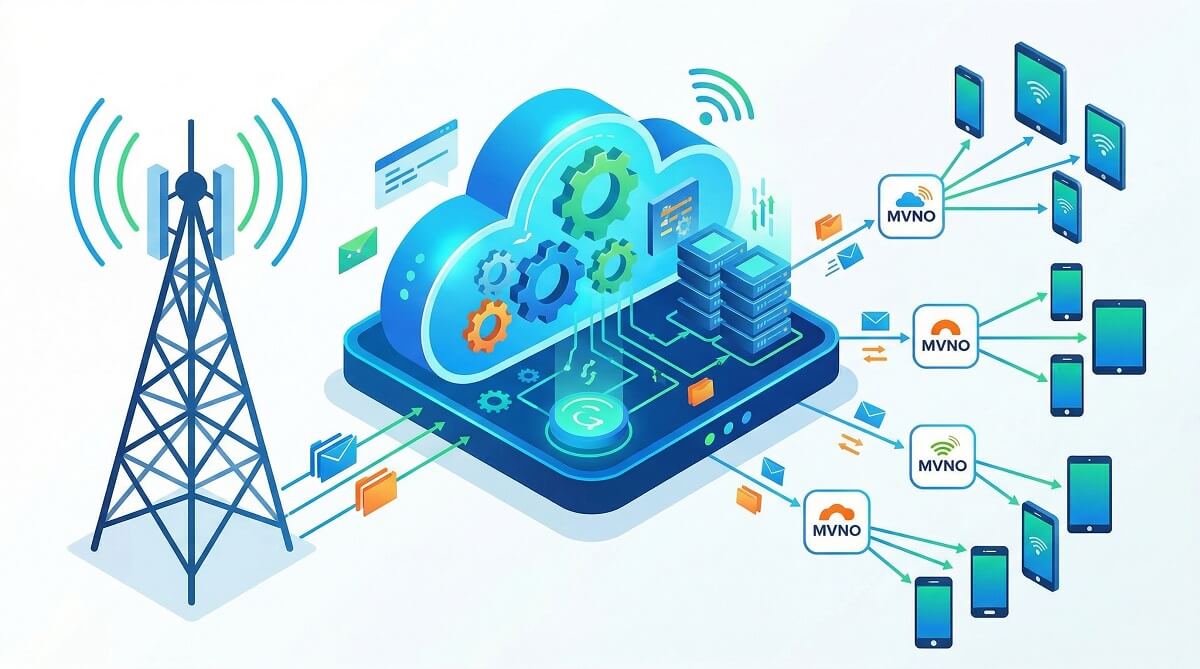
A mobile virtual network enabler (MVNE) is a B2B company that provides the technical backbone — billing, SIM provisioning, network access, and operational software — that lets other businesses launch mobile services under their own brand. You hire the MVNE to handle the telecom infrastructure work. You focus on customers and marketing.
MVNEs serve companies that want to offer mobile plans, run large-scale IoT deployments, or add connectivity to their existing product without investing in physical network gear or negotiating separately with AT&T, Verizon, and T-Mobile. They are strictly upstream B2B — an MVNE never bills your customers or puts its name on a SIM card.
If you want to sell mobile plans, connect devices, or bundle a SIM into your product, an MVNE is how you get there in months rather than years — and for hundreds of thousands of dollars rather than millions.
Who Should (and Shouldn’t) Use an MVNE
✅ An MVNE Makes Sense If You:
- Want to launch a mobile brand (MVNO) with limited or no telecom experience
- Are a retailer, fintech, or IoT company adding connectivity to your product
- Need to be live in under 90 days
- Have startup capital under $1M and can’t absorb a multi-year infrastructure build
- Want billing, SIM management, and provisioning handled by specialists
❌ Building Your Own Infrastructure Makes More Sense If You:
- Have $5M or more in capital and an 18-month runway before launch
- Need total control over billing customization and core network elements
- Are already a licensed carrier with existing infrastructure
- Have a subscriber base large enough to justify owning the full stack
The Telecom Ecosystem: MNO, MVNE, MVNA, and MVNO
The mobile industry runs on a supply chain that most people never see. Understanding where an MVNE sits in that chain explains why they exist and what problem they solve.
The Four Roles — and How They Connect
| Entity | Owns Network? | Serves Consumers? | Primary Role |
|---|---|---|---|
| MNO (Mobile Network Operator) | Yes | Yes | Physical infrastructure owner — the towers, spectrum, and core network (AT&T, Verizon, T-Mobile) |
| MVNE (Mobile Virtual Network Enabler) | No | No — B2B only | Provides the technical platform and operations infrastructure to MVNOs |
| MVNA (Mobile Virtual Network Aggregator) | No | No — B2B only | Buys wholesale capacity from MNOs in bulk and resells it to multiple MVNOs |
| MVNO (Mobile Virtual Network Operator) | No | Yes | Consumer-facing mobile brand — markets plans, manages subscribers, sets pricing |
According to Gartner’s IT Glossary, an MVNE “provides network infrastructure and related services, such as business support system (BSS) and operation support system (OSS) to a mobile virtual network operator (MVNO).” Wikipedia’s definition is similar: a company that provides “network infrastructure and related services to a mobile virtual network operator.”
One thing most new MVNO founders don’t realize: because MVNEs serve businesses rather than consumers directly, most US jurisdictions don’t classify them as public telecom providers. That means they typically don’t need a telecom license — unlike the MVNOs they support.
MVNE vs. MVNA — What’s the Difference?
An MVNE delivers technical enablement: billing software, OSS/BSS platforms, SIM provisioning, and core network elements. An MVNA delivers commercial access: it buys bulk network capacity from MNOs and resells it to smaller operators at better pricing.
In practice, many providers combine both roles. A new MVNO often works with an MVNE/MVNA simultaneously — the MVNE handles the operational platform, while the MVNA handles cost-effective network capacity.
What Does an MVNE Actually Do? Core Services Explained
The short answer: an MVNE handles everything a mobile operator needs except physical towers and consumer marketing. Here’s what that breaks down to in practice.
BSS — Business Support Systems
BSS covers the commercial operations side of running a mobile service:
- Billing and real-time charging — prepaid and postpaid Online Charging Systems (OCS), convergent billing
- CRM and subscriber management — customer records, support workflows, account status
- Product catalog — creating and managing service plans, promotions, and bundle pricing
- Revenue management — rating, discounting, settlement records for wholesale tenants
- Payment processing — integration with Stripe, PayPal, and other processors
OSS — Operations Support Systems
OSS covers the technical operations side:
- Network inventory management (tracking SIMs, devices, number ranges)
- Fault monitoring and SLA tracking
- Service activation and configuration
- Performance dashboards and analytics
SIM and eSIM Management
A solid MVNE handles the full SIM lifecycle — activation, suspension, replacement, and porting. Increasingly important: eSIM and remote SIM provisioning. As of 2025, 40% of US devices are already eSIM-enabled, according to 1Global’s connectivity trends report. The GSMA’s SGP.32 industrial eSIM standard, ratified in June 2024, is now pushing IoT deployments toward remote SIM provisioning at scale. Any MVNE without eSIM support is already behind.
Network Access and Core Network Elements
MVNEs manage pre-negotiated wholesale agreements with US carriers, so your MVNO doesn’t have to negotiate separately with AT&T, Verizon, and T-Mobile. On the technical side, they operate subscriber databases (HLR/HSS/UDM), Session Border Controllers, SMS centers, and in some cases 5G core network components including AMF, SMF, and UPF.
The Build-vs-Buy Math: Why Most Companies Choose an MVNE
The economics of building your own MVNO infrastructure are brutal. Here’s the comparison:
| Factor | Build Your Own | Use an MVNE |
|---|---|---|
| Initial investment | $2M–$10M+ | Under $200,000 |
| Time to market | 12–18 months | ~90 days (sometimes under 1 week) |
| Technical team required | Yes — large, specialized telecom team | No — MVNE handles all technical ops |
| Break-even timeline | Up to 6 years | Much shorter; “pay as you earn” options exist |
| Ongoing costs | High: staff, software maintenance, infrastructure | Predictable monthly service fees |
According to Cardella Consulting’s MVNO launch cost guide, a full MVNO (owning core network elements) requires $2M–$10M before it starts generating revenue, with a 12–18 month timeline. A lite MVNO launching through an MVNE can get live for $100,000–$400,000. The difference is not minor.
MVNE platform fees typically run $500,000–$5M per year at enterprise scale, with revenue share models of 2–5%, or per-subscriber fees that scale with growth. Newer cloud-native providers like Telgoo5 offer consumption-based pricing where you pay based on what you earn — useful for early-stage operators.
The US MVNO market that MVNEs serve is substantial. Mordor Intelligence estimates it at $14.83–16.80 billion in 2025, growing to $20.84 billion by 2030 at a CAGR of ~7%. With 120+ MVNOs already operating in the US, the demand for MVNE services isn’t slowing down.
Top MVNE Providers in the USA
There’s no shortage of options, but these are the most established platforms active in the US market:
Plintron
One of the largest MVNEs globally. Plintron has launched over 175 MVNOs across 40+ host carriers in 31+ countries. The company won MVNE/MVNA Solution of the Year at the MVNO World Congress in both 2022 and 2023. Their end-to-end TelcoSaaS platform covers BSS, OSS, SIM management, and core network elements.
Telgoo5
New York-based and hosted on AWS, Telgoo5 integrates directly with T-Mobile and Verizon. They use a “pay as you earn” consumption model — you pay based on revenue generated rather than a fixed upfront fee. Good option for early-stage MVNOs that want predictable cost scaling. Over 20 years of telecom experience; also serves government agencies and MNOs directly.
Gigs
An API-first platform partnered with AT&T in the US. Gigs is built for tech companies, fintechs, and brands that want to add mobile as a product rather than becoming full telecom operators. They’ve worked with companies like Nubank and claim launch timelines measured in days for straightforward deployments. Their platform includes AI-powered customer service tools.
KORE Wireless
Focused specifically on IoT and M2M. KORE has 24 global carrier partnerships and is named in Gartner’s Market Guide for IoT Mobile Virtual Network Enablers. Strong choice for device manufacturers and industrial operators needing multi-country connectivity.
Transatel (NTT)
A global IoT/M2M MVNE owned by NTT. Transatel holds agreements with both AT&T and T-Mobile in the US, plus coverage in 200+ countries. Operates its own 3G/4G core network. Good fit for companies needing true multi-network redundancy and international roaming.
Who Uses MVNEs? Four Real-World Use Cases
Consumer MVNO Brands
The classic MVNE customer: a company that wants to sell mobile plans under its own brand without building a network. This includes ethnic community operators, discount brands, loyalty-focused retailers, and niche carriers targeting specific demographics. The MVNE provides everything; the MVNO handles customer acquisition and brand.
Fintech and Financial Services
One of the most visible trends of 2025. Klarna launched a $40/month unlimited 5G mobile plan in the United States. Revolut added mobile plans with unlimited calls and 20GB of international roaming. N26 launched N26 SIM in Germany with free EU/EEA roaming. All three were enabled by MVNE partnerships — none of them built telecom infrastructure. Banks and payment apps are increasingly treating mobile connectivity as a loyalty and retention product, and MVNEs make that possible without a telecom license or engineering team.
IoT and M2M Deployments
With global IoT connections projected at 30 billion devices by 2025 (per Hologram’s IoT trends research), the demand for MVNE-backed IoT connectivity is massive. Fleet management, smart agriculture sensors, health wearables, industrial equipment monitors — all of these need cellular connectivity at scale. IoT-specific MVNEs like KORE and Transatel specialize in managing millions of SIMs across multiple carrier networks simultaneously.
ISPs and Enterprise Operators
Fixed broadband providers adding wireless to their bundles (fixed wireless convergence) and large enterprises managing hundreds of employee SIMs across offices both rely on MVNE platforms for centralized SIM management. Cable companies launching wireless as an add-on are a growing segment; enterprise IT departments managing multi-carrier contracts are another.
How to Choose an MVNE: 8 Questions Worth Asking
Not every MVNE is the right fit for every business. Before signing anything, get clear answers to these:
- Which US carrier networks do you support? AT&T, Verizon, T-Mobile, or multi-carrier? Single-carrier dependency is a risk.
- What is your SLA and uptime guarantee? Downtime in a mobile service affects your subscribers directly. Get specifics in writing.
- Do you support eSIM and remote SIM provisioning? With 40% of US devices already eSIM-enabled, this isn’t optional for new launches.
- What is your typical implementation timeline? Verify their claim — “90 days” varies widely depending on integration complexity and your technical readiness.
- How does your billing system handle real-time charging? Prepaid operators in particular need an Online Charging System (OCS) that processes charges before service is delivered.
- Do you offer white-label self-care portals and apps? Your customers will need a way to manage their accounts without calling support.
- What analytics and fraud detection tools are included? EIR modules, churn prediction, and usage analytics should be standard — not add-ons.
- What does vendor exit look like? If this partnership ends, can you port your subscriber data? What are the exit fees? This question reveals a lot about how a vendor operates.
Frequently Asked Questions About Mobile Virtual Network Enablers
Does an MVNE need a telecom license in the USA?
Generally no. MVNEs provide upstream B2B services without a direct relationship with end consumers. Most US jurisdictions don’t classify them as public telecom providers, so a telecom license typically isn’t required — unlike MVNOs, which do serve consumers and usually need appropriate licensing.
How long does it take to launch an MVNO using an MVNE?
Most MVNE platforms can have a new operator live in 60–90 days. API-first platforms like Gigs can launch simpler deployments in days or weeks. The timeline depends heavily on how much customization you need and how quickly your team can complete integration testing.
What’s the difference between a full MVNO and a light MVNO?
A full MVNO owns some network elements — typically its own HLR or subscriber database. A light MVNO (also called “skinny” or “thin”) relies entirely on the MVNE’s infrastructure. Light MVNOs are significantly cheaper and faster to launch, which is why most new entrants start there.
Can a retail brand or fintech launch mobile services through an MVNE?
Yes — and this is no longer unusual. Klarna launched a $40/month 5G plan in the US through MVNE partnerships. Revolut and N26 did the same in Europe. Any brand with a customer base and a reason to offer connectivity can work with an MVNE without building telecom infrastructure or hiring a single network engineer.
How do MVNEs make money?
Through platform fees: fixed annual charges ($500,000–$5M/year for enterprise scale), per-subscriber monthly fees, revenue share arrangements (typically 2–5% of gross service revenue), or consumption-based “pay as you earn” models that scale with MVNO growth.
What is “MVNO in a box”?
A pre-integrated, ready-to-deploy MVNO package that includes billing, CRM, provisioning, and network access in one offering. Most modern MVNEs offer some version of this. It’s essentially a turnkey setup rather than a custom integration project.
Is eSIM support important when evaluating an MVNE?
Yes. As of 2025, 40% of US devices are eSIM-capable, and that percentage is rising fast. An MVNE without eSIM support limits your ability to offer instant activation — a competitive disadvantage as consumer expectations shift toward no-physical-SIM onboarding.
What happens to my MVNO if my MVNE shuts down or terminates the contract?
This is a real risk that many new MVNO operators don’t think through. Before signing, ask specifically about data portability, subscriber record ownership, and exit clause terms. If a vendor can’t give you clear answers here, that’s worth taking seriously.
The Bottom Line
A mobile virtual network enabler is the infrastructure layer that makes it possible for companies to offer mobile services without owning a network. For most businesses — whether you’re launching a consumer mobile brand, connecting IoT devices, or bundling a SIM into a fintech product — the economics strongly favor using an MVNE over building your own stack. The capital difference alone ($200K vs. $2–10M) makes it the default choice for anyone without existing telecom infrastructure.
The market for MVNE-backed services is growing. With 120+ MVNOs in the US, fintech brands entering the mobile space, and IoT deployments scaling into the billions, demand for capable MVNE platforms isn’t leveling off anytime soon. If you’re evaluating whether mobile services belong in your business model, the question isn’t whether you need an MVNE — it’s which one fits your vertical.
