


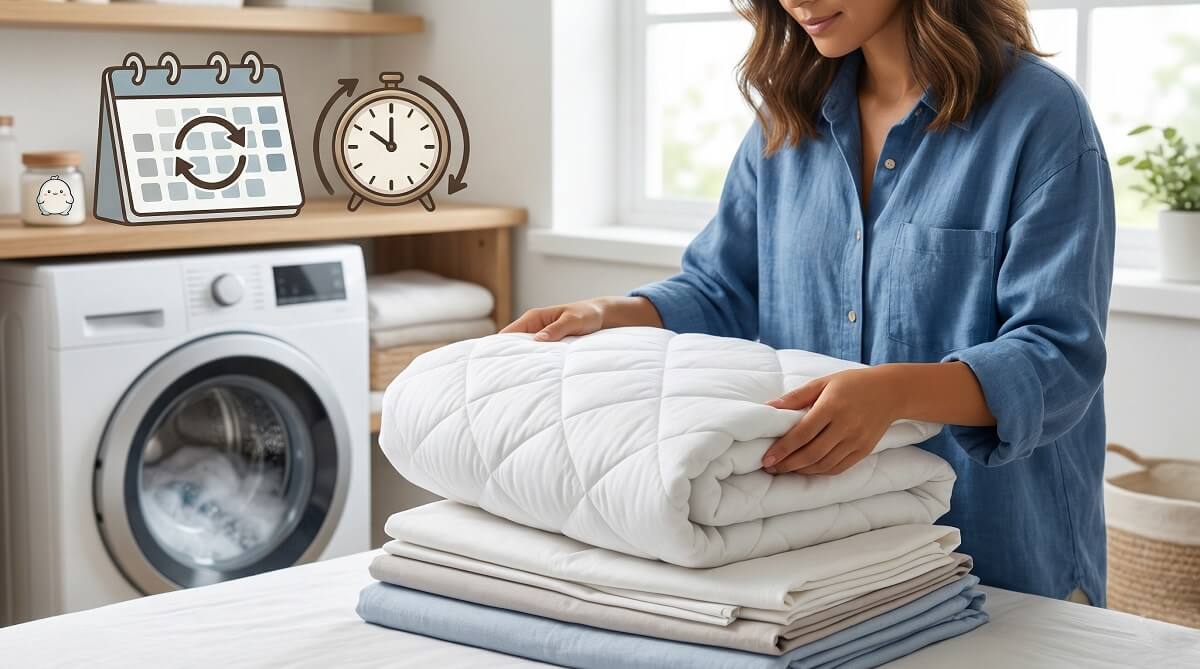
For most households, washing a mattress protector every one to two months keeps things sanitary without overdoing it. Under normal conditions — one adult sleeper, no pets in the bed, no accidents or spills — that schedule is plenty. A protector sitting under your fitted sheet doesn’t get as grimy as your pillowcase, but it does accumulate sweat, dead skin cells, and eventually dust mite waste if you leave it too long.
That two-month baseline shifts fast depending on your situation. If you have allergies or asthma, washing every two to four weeks makes a meaningful difference — . After an illness, a spill, or a nighttime accident, don’t wait for your next scheduled laundry day. Strip it and run it that day. The same goes for anyone who shares the bed with a dog or cat.
This guide covers the full washing schedule by situation, the right way to actually clean a mattress protector without wrecking the waterproofing, and the signs that a wash won’t cut it anymore and it’s time to replace the thing.
Quick Schedule: How Often to Wash Based on Your Situation
| Your Situation | Wash Frequency |
|---|---|
| Average adult sleeper, no pets, no allergies | Every 1–2 months |
| Allergy or asthma sufferer | Every 2–4 weeks |
| Pets sleep in the bed | Monthly |
| After illness or fever | Immediately |
| After a spill or accident | Immediately |
| Guest bedroom (light use) | Every 3–4 months |
| Brand new protector (first use) | Before first use |
✅ The 1–2 month schedule works if you:
- Sleep alone or with one other person and no pets
- Don’t have allergies or respiratory conditions
- Haven’t had any spills, accidents, or illness recently
- Wash your bed sheets weekly
❌ Wash more often if you:
- Have allergies, asthma, or eczema (bump up to every 2–4 weeks)
- Share the bed with a pet
- Sweat heavily at night
- Had a spill, accident, or recently recovered from illness
- Just bought a new protector (wash it before putting it on the mattress)
Why the Washing Schedule Actually Matters
Dust mites are the main reason a mattress protector needs regular washing. According to the National Library of Medicine, approximately 84% of US households have detectable dust mites, and an estimated 20 million Americans have a dust mite allergy. Among people with asthma who also have allergies, 40–85% are allergic to house dust mites specifically.
The mites themselves are microscopic. What actually triggers allergic reactions — runny nose, itchy eyes, worsened asthma symptoms — is their fecal particles. A single dust mite produces roughly 2,000 fecal particles over its 65–100 day lifespan. CDC/ATSDR research identifies dust mite exposure as a key factor in asthma exacerbations. The mites favor warm, humid environments — which is exactly what a mattress protector provides.
Your mattress protector’s job is to act as a physical barrier between your mattress and all of that — sweat, skin cells, spills, and whatever the mites leave behind. But it can only do that job if you’re cleaning it regularly. is the first line of defense for your mattress, but a dirty one doesn’t offer much protection.
A Note on Washing Temperature and Dust Mites
You may have read that washing at 140°F (60°C) kills 100% of dust mites, and that’s accurate. Cold water at 30°C only eliminates about 6.5% of them by temperature alone. However — washing a waterproof mattress protector at 140°F will destroy the waterproof lining. Most manufacturers cap the safe wash temperature at 104°F (40°C), per Sleep Foundation’s care guidance.
The practical solution: laundering at the safe lower temperature still works. Cold water mechanically removes 60–83% of live mites even without the heat kill effect. Regular washing flushes out the allergen-carrying particles before they build to problematic levels. The protector itself provides a physical barrier so mites can’t reach your mattress. You don’t need to choose between killing mites and keeping the protector intact — consistent cleaning at the right temperature handles both jobs well enough.
How to Wash a Mattress Protector (4 Steps)
Mattress protectors are straightforward to launder, but a few missteps — mainly high heat and the wrong products — can shorten their lifespan significantly. Here’s what actually works.
Step 1: Read the Tag First
The care label on your specific protector overrides everything else in this guide. Most waterproof protectors call for a gentle or delicate cycle with cold to warm water (up to 40°C/104°F). Some specialty materials — certain vinyl covers, for example — require hand washing or dry cleaning only. If the tag says dry clean, don’t try to machine wash it to save time.
For the majority of standard waterproof or quilted protectors, you’ll see: machine wash, gentle cycle, low or no heat in the dryer.
Step 2: Pre-Treat Any Stains Before Loading
Don’t just toss a stained protector straight into the machine. A few targeted treatments make a bigger difference than the wash cycle alone:
- Blood: Rinse immediately with cold water only — warm water sets protein stains. Dab a small amount of liquid dish soap or hydrogen peroxide on the spot.
- Urine: Rinse with cold water, then apply an enzyme-based cleaner (or a baking soda paste) and let it sit for 15 minutes. Enzyme cleaners break down the organic compounds that cause odor.
- Sweat/yellowing: A 15-minute soak in diluted white vinegar (1 part vinegar to 2 parts water) before washing loosens the buildup.
- Food or drink: Blot (don’t rub) with liquid dish soap and cold water, then let it sit for a few minutes before loading.
Step 3: Load and Wash Correctly
A few things that matter here:
Machine capacity: A queen or king mattress protector needs room to move around in the drum. For a queen-size protector, you need a washer with at least 3.5 cubic feet of capacity — no agitator (front-load or HE top-load). King-size protectors need a 5–6 cu ft machine. If your home washer is a compact unit, a trip to the laundromat is worth it to avoid a machine that can’t properly clean or rinse the protector.
Detergent: Use a mild, fragrance-free liquid detergent in roughly half the normal amount. The protector doesn’t need the same load as a full pile of jeans. More detergent doesn’t mean cleaner — it means harder to rinse out.
No bleach: Chlorine bleach degrades waterproof coatings and weakens fabric fibers over time. Skip it even for stains — enzyme cleaners handle the job without the damage.
No fabric softener: This one catches people off guard. According to SafeRest’s official guidance, fabric softeners damage the waterproof lining. The mechanism: softener leaves a residue that clogs the microscopic pores in the protective coating, reducing both breathability and waterproof effectiveness. Skip dryer sheets for the same reason.
Cycle settings: Gentle or delicate cycle, cold to warm water (max 40°C/104°F). Add a second rinse if your machine allows it — detergent residue left in the fabric causes skin irritation and breaks down materials faster.
Wash it alone, or close to it: Washing with your sheets is fine if the load isn’t overstuffed. Avoid washing with towels or heavy items that don’t leave the protector room to agitate properly.
Step 4: Dry It Fully — No Shortcuts
This step matters more than people realize. A mattress protector that goes back on the bed even slightly damp creates the exact warm, humid environment dust mites thrive in — and can lead to mildew in the mattress underneath.
Dryer: Low heat only. High heat destroys the polyurethane membrane in waterproof protectors and causes shrinkage. Toss in a couple of dry towels or wool dryer balls to speed drying and prevent the protector from balling up in the drum.
Air drying: Lay it flat or hang it over a drying rack with airflow on both sides. In direct sunlight works well. Expect 4–6 hours for a full air dry depending on thickness and humidity. Feel the waterproof backing specifically — it retains moisture longer than the fabric face.
Do not iron. Heat damage is the most common way waterproof protectors fail prematurely.
Washing by Material Type — What Changes
Most mattress protectors on the market are waterproof with a polyurethane or TPU backing. But the care instructions shift depending on what you have. covers how to pick the right type for your needs.
Waterproof Protectors (Polyurethane / TPU Backed)
The most common type — and the one with the strictest temperature limits. The waterproof layer is a laminated coating bonded to the fabric with adhesive. That adhesive breaks down with heat, not just with washing cycles in general.
- Maximum wash temp: 40°C / 104°F
- Dryer: Low heat only, or air dry
- No bleach, no fabric softener — both damage the protective layer
- Lifespan: 1–2 years with proper care; the waterproofing may begin degrading after repeated high-heat washes well before that
Cotton Terry or Quilted Protectors (Non-Waterproof)
Easier to care for. Cotton terry tolerates slightly warmer water and a standard cycle without the same risk of membrane damage. Still keep dryer heat moderate to avoid shrinkage and wear.
- Wash temp: Up to 60°C / 140°F (which also kills dust mites — a bonus for allergy sufferers)
- Standard or gentle cycle
- Holds moisture longer than synthetic types — allow extra dry time
Bamboo or Organic Cotton Protectors
These use natural fibers that are softer but more prone to heat damage and shrinkage.
- Wash temp: Cold to warm (30–50°C max, depending on brand)
- Gentle cycle
- Air drying preferred — bamboo fibers can shrink in high heat
- Check the label specifically, as organic fabric care varies more by manufacturer
| Material | Max Wash Temp | Dryer Setting | Fabric Softener | Bleach |
|---|---|---|---|---|
| Waterproof (PU/TPU) | 40°C / 104°F | Low heat only | No — damages membrane | No — degrades coating |
| Cotton Terry / Quilted | 60°C / 140°F | Medium-low | Optional | Occasional (diluted) |
| Bamboo / Organic Cotton | 30–50°C | Low / Air dry | No — residue buildup | No |
When Spot Cleaning Is Enough (and When It Isn’t)
A full machine wash every time there’s a minor mark isn’t necessary — and frequent washing does accelerate wear on waterproof materials. Spot cleaning makes sense for small isolated stains or light surface dust between scheduled washes.
Spot Cleaning Method
- Dampen a clean cloth with cold water
- Add a small drop of mild liquid detergent
- Blot the stain — don’t scrub, which spreads it and works liquid deeper into the layers
- Rinse the spot with a clean damp cloth to remove detergent
- Allow to air dry completely before replacing on the mattress
For odors between washes: sprinkle baking soda over the dry protector, let it sit for 30 minutes, then vacuum it off. This handles light smells without putting the protector through a full wash cycle.
When Spot Cleaning Isn’t Enough
Spot cleaning handles surface stains — it does nothing for dust mite allergen load, bacteria, or sweat residue distributed across the full surface. If your regular schedule calls for a wash and you have a spot, the answer is to machine wash the whole thing. If someone was sick, or there was a significant spill that soaked through, don’t spot clean and put it back. in those cases.
When to Replace Your Mattress Protector
No amount of washing fixes a protector that has physically broken down. The most common sign with waterproof types is simple: liquid soaks through instead of beading up on the surface. When that happens, the protective membrane has failed and the protector is no longer doing its job.
Do the bead test: Pour a small amount of water on the surface. If it beads and rolls off, the waterproofing is intact. If it absorbs into the fabric, the membrane has degraded — time for a new one.
Other signs it’s time to replace rather than rewash:
- Persistent odor that survives multiple machine washes
- Visible thinning, pilling, or worn patches in the fabric
- Elastic corners that no longer grip the mattress edges
- Discoloration that won’t wash out after pre-treatment
With regular use and proper care, most waterproof mattress protectors last one to two years. Cotton and bamboo protectors without a waterproof layer can last longer — up to three to four years — since they don’t have the membrane degradation issue.
When you do need a replacement, a basic waterproof protector doesn’t have to be expensive. The SafeRest Premium (queen) runs around $35–$40, and the Linenspa Encasement (queen) is typically under $30. Check Amazon for current pricing on both. You can also find on ChubbytIps to compare options before buying.
Frequently Asked Questions
How often should you wash a mattress protector?
Every one to two months under normal conditions. If you have allergies or asthma, every two to four weeks. After illness, a spill, or an accident, wash it immediately regardless of when you last cleaned it.
Can you put a mattress protector in a regular washing machine?
Most are machine washable, but the machine needs to be large enough. Queen-size protectors need a washer with at least 3.5 cubic feet (front-load or agitator-free HE top-load). King-size protectors need 5–6 cubic feet. A small compact washer doesn’t give the protector enough room to wash and rinse properly — take it to a laundromat if needed.
What happens if you never wash your mattress protector?
Sweat, dead skin cells, and dust mite allergens build up over time. For people with allergies or asthma, this worsens symptoms. The protector also starts to smell, and prolonged neglect can lead to staining that won’t come out and material breakdown that shortens the protector’s useful life.
Can you put a mattress protector in the dryer?
Yes, but only on low heat. High heat is the main cause of premature waterproofing failure. The polyurethane membrane that makes a protector waterproof is heat-sensitive — once it degrades, the protector won’t be waterproof anymore. Air drying is the safest option, though it takes a few hours.
Should you wash a new mattress protector before using it?
Yes. New protectors often carry manufacturing residues and a faint chemical smell. Washing before first use removes those residues and softens the fabric, making it more comfortable right away.
Can you use bleach on a mattress protector?
No. Chlorine bleach breaks down waterproof coatings and weakens fabric fibers. For sanitizing or stain treatment, use an enzyme-based cleaner instead — it handles biological stains (urine, blood, sweat) without damaging the protector.
How do you get urine out of a mattress protector?
Rinse immediately in cold water — never warm or hot, which sets protein-based stains. Apply an enzyme cleaner or a paste of baking soda and water, let it sit for 15 minutes, then machine wash on a gentle cold cycle. If the smell persists after washing, repeat the enzyme cleaner treatment before the next wash.
How long does a mattress protector last?
With proper care — low-heat drying, no bleach, no fabric softener — most waterproof protectors last one to two years. Do the bead test periodically: pour a small amount of water on the surface. If it absorbs instead of beading up, the waterproof layer has failed and it’s time for a replacement.
When your protector wears out, check current prices on Amazon for options like SafeRest and Linenspa. Browse more on ChubbytIps for related tips.
