


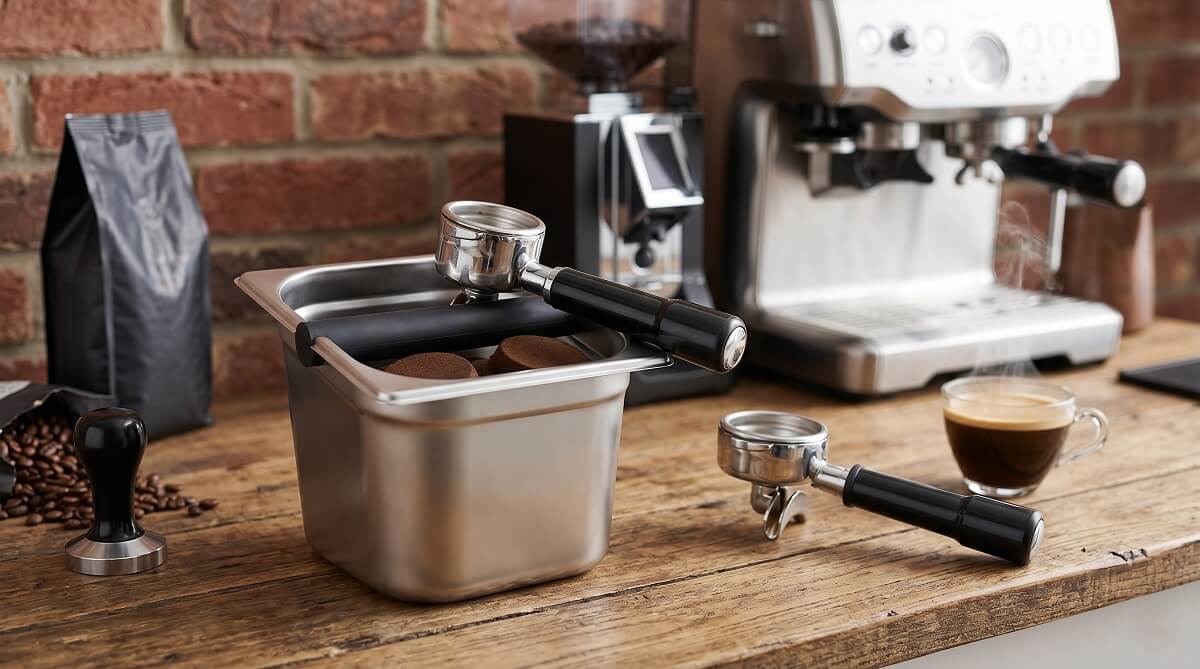
An espresso knock box is the small bin you tap your portafilter against to eject the spent coffee puck after each shot. Without one, you’re dumping wet grounds into the trash or the sink—neither of which is particularly clean or pleasant. A knock box handles it in one firm tap, keeps your counter tidy, and lets you move on to the next shot.
For most home setups, the hits the sweet spot: $33.95, a 10-puck capacity, and a compact footprint that fits neatly on any espresso station. If you pull more shots daily or have a household of coffee drinkers, the adds a bigger catch for $10 more. Want a cleaner-looking setup? The Normcore drawer-style knock box slides under your grinder and hides the mess entirely—though it costs $99.99.
The main things to match before buying: bar width (it needs to clear your portafilter), capacity (how many pucks before you’re emptying it), and material (rubber or wood if noise is a concern; stainless steel if it isn’t). The rest is personal preference.
Who Should (and Shouldn’t) Buy an Espresso Knock Box
✅ Best For
- Home espresso setups pulling 1 or more shots daily
- Anyone tired of dumping grounds into the sink or trash
- Small countertops (compact models take up minimal space)
- Home baristas who want a tidier, more intentional workflow
- Apartment dwellers who need a quieter knock solution (wood or rubber-lined options)
❌ Skip If
- You only pull occasional shots—a lined bin near the machine works just fine
- You own a superautomatic machine (no portafilter to knock; grounds are expelled automatically)
- You compost immediately after every shot (just use a compost-lined container)
What Is an Espresso Knock Box (and Do You Actually Need One)?
How a knock box works
After pulling a shot of espresso, the portafilter holds a compact disc of wet, compressed grounds called the spent puck. To reuse the portafilter, you need to eject that puck. A knock box is the tool designed for exactly that: you flip the portafilter over and strike it firmly against the knock bar—a padded rod spanning the top of the box. The puck drops in cleanly, and you’re ready to load fresh grounds.
The knock bar itself matters more than most people expect. A bar with a rubber coating absorbs the impact so you don’t jar your machine or your counter, and it makes considerably less noise than a bare metal rod. The container underneath should have a non-slip base to stay put during repeated strikes, and a wide enough opening to catch any stray grounds without the portafilter handle clipping the sides.
According to independent guides from HomeGrounds, a rubber-coated bar with a stable base is the single most important feature to look for in any knock box.
When you need one vs. when you can skip it
If you’re brewing espresso every morning—or multiple times a day—a knock box genuinely earns its counter space. It keeps the puck disposal quick, contained, and away from your sink drain (coffee grounds are a common cause of slow drains). If you only make an occasional shot once or twice a week, any lined container will do. A dedicated grounds bin becomes noticeably more useful once you’re pulling four or more shots per week.
What to Look for Before You Buy
Bar width and portafilter fit
Most home espresso machines use one of three portafilter sizes: 58mm (prosumer and commercial-grade machines like La Marzocco, Rocket Espresso, ECM, and Breville’s dual boiler), 54mm (Breville Bambino, De’Longhi Dedica and similar mid-range machines), or 51mm (some compact and Nespresso-compatible machines). The vast majority of knock boxes on the market comfortably accommodate 58mm portafilters, since that’s the standard for most dedicated espresso setups.
The exception worth noting: some budget models have narrower container openings. As HomeGrounds pointed out in their testing, the Easgiu knock box has an opening that “feels a little narrow, especially with a full-size 58mm portafilter.” Before purchasing a smaller or less-known brand, check that the inner opening diameter is at least 5 inches if you’re using a 58mm portafilter. You can cross-reference this with our for more compatibility tips.
Capacity — how many pucks before emptying?
Knock box capacity is usually described in puck count or volume (milliliters). For practical reference: a standard double espresso puck is roughly 20-22mm thick when tamped. The Breville Knock Box 10 holds 10 pucks before it needs emptying; the Knock Box 20 holds 20. For most home users pulling 1-2 shots per day, a 10-puck box means emptying it roughly once a week—completely manageable. According to guidance from Barista Life, a 10-15 puck capacity is sufficient for typical home use, while offices or households with multiple espresso drinkers should look at 20-puck options or larger.
Material — noise and durability
The material of the knock box body and bar affects both sound and longevity:
- ABS plastic: Lightweight and affordable. Perfectly functional for home use. Dishwasher-safe in most cases. Not as visually striking as metal but quiet when paired with a rubber bar.
- 304 stainless steel: Corrosion-resistant and long-lasting. Heavier, which helps with stability. Can amplify knock noise if there’s no rubber lining on the bar or base. Higher-end stainless models (like the Normcore) add rubber feet and nylon runners to absorb sound.
- Maple wood: The quietest knock option by a clear margin. Looks great on a coffee station. Requires more cleaning care—don’t soak it or put it in the dishwasher. Best for aesthetics-first home baristas who want a calm morning routine.
Barista Life’s buying guide notes that “rubber feet, sound-dampening materials, and stable base geometries all contribute to quieter operation”—something worth paying attention to if you’re brewing espresso before anyone else in your home wakes up. Browse our for more gear that keeps your station running quietly.
Style — bin vs. drawer
Traditional knock boxes are standalone bins: you set them on the counter, knock, and move on. They’re portable, affordable, and come in every price tier. The drawer-style knock box, most notably the Normcore model, slides under your espresso grinder and acts as a catch tray that’s hidden from view. You pull the drawer out to empty it. This setup looks significantly cleaner on the counter and integrates naturally into a compact espresso station.
The tradeoff: the Normcore drawer runs $99.99 and is designed to sit beneath specific grinder footprints. The Size S (11 × 5.5 × 2.8 in) fits well under smaller grinders like the Niche Zero and Fellow Ode; the Size M (12.4 × 6.7 × 3.4 in) suits wider machines. If you have a large or unusual grinder base, measure before ordering.
Cleaning
Most knock boxes with a removable bar can be rinsed in 30 seconds. Some are fully dishwasher-safe (the Breville Knock Box 20’s inner vessel, for instance). Stainless steel bins without a removable liner typically need a quick wipe and occasional rinse—no special treatment required. Wood models need handwashing and regular drying to prevent staining or mold. Empty the grounds every 1-3 days for home setups to keep things odor-free.
Espresso Knock Box Comparison
All prices as of March 2026. Check retailers for current availability.
| Model | Style | Material | Capacity | Price | Best For |
|---|---|---|---|---|---|
| Breville Knock Box 10 (BEA501BSS) | Bin | Stainless + plastic | 10 pucks | $33.95 | Best overall for most home setups |
| Breville Knock Box 20 (BEA502BSS) | Bin | Stainless + plastic | 20 pucks | $43.95 | Households with 2+ espresso drinkers |
| Normcore Knock Box Drawer | Drawer | 304 Stainless Steel | Varies (S/M) | $99.99 | Counter organization, grinder pairing |
| Rattleware Stainless Heavy Duty | Bin | Brushed stainless | Medium | $26.95 | Budget stainless option |
| Rattleware Maple Knockbox Set | Bin | Maple wood | Medium | $64.99 | Quiet knock, premium counter look |
| Rocket Espresso Stainless Knock Box | Bin | Stainless steel | Large | $83.95 | Prosumer setups, Rocket machine owners |
| MHW-3BOMBER Square Knock Box | Bin | ABS + SUS304 bar | 1200ml | Check current price | High-capacity ABS option |
Prices sourced from Seattle Coffee Gear and Normcore official as of March 2026.
Top Picks by Use Case
Best overall: Breville Knock Box 10
At $33.95, the Breville Knock Box 10 does everything a home barista needs without overcomplicating it. It holds 10 pucks, has a removable knock bar for quick cleaning, and sits steadily on the drip tray of most Breville machines. The brushed stainless finish matches Breville’s espresso line if that kind of thing matters to you. According to , the Breville knock box consistently ranks as a top pick for home setups because it’s “die-cast metal with the same attractive brushed finish found on Breville coffee machines” and provides a wide opening that handles 58mm portafilters without issue. Check current pricing on Amazon.
Best for higher volume: Breville Knock Box 20
If two or more people in your home drink espresso regularly, the Knock Box 20 at $43.95 gets you to 20 pucks between empties. The inner vessel is dishwasher-safe, which makes cleanup easier when you do get around to it. Seattle Coffee Gear describes it as “ludicrously capacious” for a home setup—fair enough. Check pricing at Seattle Coffee Gear or Amazon.
Best for counter organization: Normcore Knock Box Drawer
The is for home baristas who want their espresso station to look intentional, not haphazard. At $99.99, it’s a premium purchase, but the drawer mechanism slides under most compact grinders and keeps spent grounds completely out of sight. The 304 stainless steel construction is built to hold significant weight—you can rest the grinder on top—and the rubber feet prevent sliding during hard knocks. Size S fits Niche Zero and Fellow Ode; size M suits wider machines. Order directly from Normcore’s website.
Best budget stainless: Rattleware Stainless Heavy Duty
At $26.95 from Seattle Coffee Gear, the Rattleware stainless knock box is the most affordable all-metal option that’s actually worth owning. It’s not fancy—no rubber bar, no drawer—but it’s built solidly enough for daily home use. Good for anyone who wants the durability of stainless without the Breville premium.
Best for quiet knocking: Rattleware Maple Knockbox Set
Wood absorbs impact the way metal can’t. The Rattleware Maple Knockbox Set at $64.99 is the go-to pick for apartment dwellers or anyone making espresso before their household is awake. The knock bar strikes are noticeably muffled compared to any metal option. The tradeoff: maple needs handwashing and careful drying. Don’t soak it, and dry it after rinsing.
Frequently Asked Questions
What is an espresso knock box used for?
A knock box is a container with a padded bar used to eject the spent coffee puck from an espresso portafilter. After pulling a shot, you flip the portafilter and strike it against the bar to drop the used grounds into the bin. It keeps the puck disposal quick, contained, and off your counter.
Do I need a knock box if I have a superautomatic espresso machine?
No. Superautomatic machines grind, tamp, brew, and eject the spent puck automatically into an internal grounds container. You don’t interact with a portafilter, so a knock box isn’t needed. They’re only relevant for semi-automatic or manual machines where you load and remove the portafilter yourself.
What size knock box do I need for home use?
For a single home user pulling 1-2 shots per day, a 10-puck capacity knock box (like the Breville Knock Box 10) works well and needs emptying roughly once a week. Households with multiple espresso drinkers should consider 20-puck options. According to and independent reviews, a 4-6 inch diameter bin handles typical home use comfortably.
What knock box works with the Breville Barista Express?
The Breville Barista Express uses a 54mm portafilter. The Breville Knock Box 10 and 20 are designed to integrate with Breville’s espresso line and work well with the Barista Express. The Knock Box 10 even fits neatly on the drip tray. Any knock box with an opening wider than 5 inches will also accommodate a 54mm portafilter without issue.
Are knock boxes dishwasher safe?
It depends on the model. The Breville Knock Box 20’s inner vessel is dishwasher-safe. Most plastic and ABS knock boxes can go in the dishwasher. Stainless steel models typically need handwashing to prevent water spotting. Wood knock boxes should never go in the dishwasher—handwash and dry immediately.
How often should I empty a knock box?
For home use, emptying every 2-3 days is a reasonable habit. Wet coffee grounds can develop mold or odors if left too long, especially in warm kitchens. Knock boxes with removable bars or liners are faster to empty and rinse.
Can I use a knock box for pour-over or drip coffee grounds?
Technically yes, though knock boxes are designed for the compact, solid espresso puck. Looser pour-over or drip grounds will scatter more when dropped in, and the knock bar serves no purpose for those methods. A lined bin or compost container works better for non-espresso brewing.
What’s the difference between a knock box and a grounds container?
A knock box has a knock bar—the padded rod you strike the portafilter against. A grounds container is just a bin with no bar, used to collect loose grounds. Some espresso machines include a grounds container in their design (like superautomatic machines), but for manual espresso, a knock box with a bar is what you want.
Ready to Pick One?
For most home setups, start with the Breville Knock Box 10 or 20. Both are solid, affordable, and widely available. Check current prices on Amazon or browse the full range at Seattle Coffee Gear. If counter organization is the goal, the is worth the premium.
