


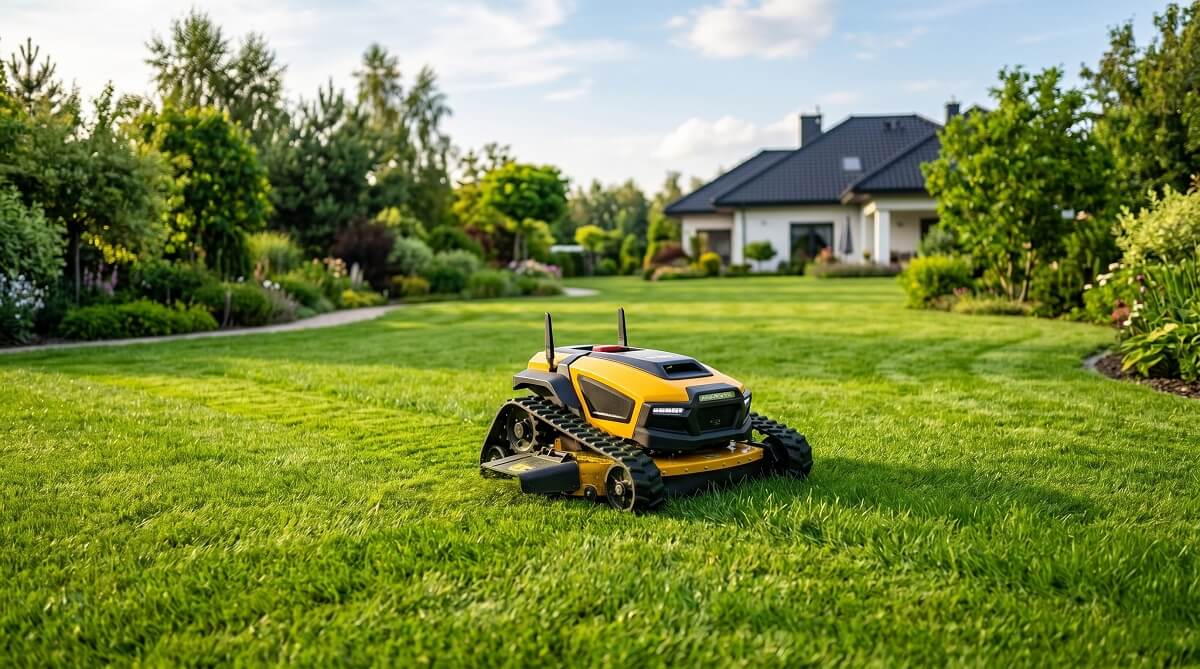
A remote controlled lawn mower lets you cut grass while standing safely off to the side. You hold a handheld controller — joystick or thumbstick — and guide the machine in real time. For a flat yard, you probably don’t need one. But if you have a slope steeper than 15–20 degrees, a retention pond edge, a drainage ditch, or any terrain where a riding mower could tip over, an RC mower solves a real problem that other equipment can’t.
Prices start around $2,000 on Amazon for basic electric crawler models and climb past $5,000 for 4WD residential units with multi-season attachments. used by contractors and government agencies run $10,000 and up. Most homeowners shopping for a residential solution will land somewhere in the $2,000–$4,000 range depending on how steep and how large their problem areas are.
This guide focuses on the US market. We’ll walk through how these machines work, what the key specs mean in plain language, which models are worth looking at, and how to figure out whether the investment makes sense for your yard.
Who Should (and Shouldn’t) Get a Remote Controlled Lawn Mower
✅ Best For
- Homeowners with slopes steeper than 15 degrees where a riding mower feels risky
- Properties with retention pond banks, embankments, or drainage ditches
- Anyone who has tipped or nearly tipped a riding mower on a grade
- Landscaping contractors who want to take on slope jobs competitors won’t touch
- Property managers maintaining roadsides, commercial grounds, or park hillsides
- People paying a landscaping crew specifically to handle the dangerous sections
❌ Skip If
- Your lawn is mostly flat — a robot mower or standard riding mower handles this better and cheaper
- You want something fully autonomous (look at robotic mowers; RC mowers require active operator control)
- Your budget is under $1,500 — options below that threshold are generally fragile or underpowered
- Your difficult terrain is under a quarter-acre — the investment may not pencil out vs. hiring help
How a Remote Controlled Lawn Mower Actually Works
The basics
The setup is straightforward: you stand at a safe distance and use a handheld controller to guide the mower across the ground. No sitting on the machine, no walking behind it. The mower responds in real time to your inputs — forward, reverse, turning, speed adjustment. Most consumer units have an effective operating range of 200–650 feet. Commercial machines like the RC Mowers USA R-Series reach up to 1,000 feet.
All quality units include a dead-man switch or signal-loss auto-stop. If the machine goes out of range, loses signal, or if you release the controller, it shuts down automatically. Tilt and drop sensors add another layer — if the mower rolls over or falls, it powers off immediately.
Electric vs. gas-powered
Consumer RC mowers today are almost entirely electric. The Mowrator S1 runs a 1,600W motor — about the same output as a midsize gas mower — and uses a 56V lithium iron phosphate (LiFePO4) battery that delivers up to 2.25 hours of runtime and covers roughly 4,500 square meters (about 1.1 acres) per charge. Charge time with the 600W fast charger is around 90 minutes. The battery is rated for 1,500+ charge cycles, compared to roughly 500 for standard lithium-ion robot mower batteries.
Gas-powered units are the commercial standard. The RC Mowers USA R-52 runs a Vanguard 37 HP EFI engine and can operate for a full working day. Commercial gas units weigh over 2,000 pounds and move through dense brush that consumer electric units can’t handle — but they’re priced and sized for professional crews, not homeowners.
RC mower vs. robotic mower — the key distinction
This trips up a lot of buyers. A robotic mower operates autonomously — it follows a GPS boundary or perimeter wire, maps your lawn, and mows while you’re not watching. A remote controlled mower requires you to steer it every moment it’s running. You’re in the loop, watching it work, guiding it through obstacles and around edges.
That distinction matters because robotic mowers struggle on steep, uneven terrain. The navigation systems and lightweight chassis aren’t built for slopes above 30–35 degrees. RC mowers are specifically designed for the terrain where autonomous navigation becomes unreliable — which is exactly why they exist as a separate category. for your specific terrain.
Price Ranges: What You Get at Each Level
Around $2,000–$3,000 — Entry-level electric RC mowers
At the lower end of the market, you’ll find tracked electric crawler mowers on Amazon in the $2,099 range. These typically offer a 21.5-inch cutting deck, 60° slope capability, adjustable cutting height from 0–10.2 inches, and a remote range of around 1,640 feet. Shipping is usually freight, with lead times of 4–5 weeks for some models. They’re a reasonable starting point if your terrain is moderate and your property isn’t large.
The Farmry RM20 sits in this bracket at $2,999 (as of March 2026, item was temporarily out of stock at time of writing — check current availability at Farmry). It’s a gas-powered tracked unit with a 20.9-inch cutting deck, 35° slope rating, and a 6.1 HP EPA-compliant engine. It weighs 352 pounds and has a remote range of about 600 meters. The gas engine is a practical advantage for longer mowing sessions and heavier brush.
$3,000–$4,500 — Mid-range residential with real slope capability
This is where most residential buyers end up. The Mowrator S1 4WD 75% Slope starts at $3,149 (12Ah battery, 0.75-acre coverage) or $3,599 (18Ah battery, 1.125-acre coverage) on the US site, based on current pricing as of March 2026. Both include a leaf shredding vacuum as standard.
The 4WD drivetrain makes a real difference on grades — it handles 75% grades (about 37°), which covers the majority of steep residential hillsides. The 1,600W motor, 53 cm (21-inch) deck, and 3,200 RPM blade speed handle thick turf, kikuyu grass, and uneven ground without bogging down. The machine includes four ultrasonic obstacle sensors, tilt protection, bumper collision detection, and a remote emergency stop. According to , the PCWorld review gave the S1 4WD a 4.5/5 score, noting it completed a quarter-acre in under 20 minutes.
The Mowrator S1 also comes in a 2WD variant for milder slopes. Check mowrator.com for current US pricing across all four variants — pricing updates frequently.
$5,000–$7,000+ — Advanced multi-function units
Higher-end Mowrator variants handle slopes up to 85% and 100% (45°) with deformable tires or specialized wide-wheel configurations for maximum traction. These add multi-season versatility: snow plow attachment, leaf vacuum, towing capability, and FPV camera support. If your property has extreme grades or you want year-round utility out of one machine, these justify the premium. Check current pricing directly at mowrator.com — these models are available in the US but pricing wasn’t publicly confirmed for all variants at time of writing.
$10,000+ — Commercial-grade for professional use
The RC Mowers USA R-52 (52-inch deck, 37 HP Vanguard EFI, 50° slope, 1,000-foot range, 2,030 lbs) and R-60 (60-inch deck, 40 HP) are built for landscape contractors and government agencies — retention ponds, highway embankments, dam walls, airport perimeters. No MSRP is published; pricing requires a dealer quote. One contractor reported 92% labor savings after the first 1,000 hours of use. These aren’t household purchases — they’re equipment investments for commercial operations.
Side-by-Side Comparison
| Model | Type | Max Slope | Cutting Width | Power | Est. Price (USD) | Best For |
|---|---|---|---|---|---|---|
| Amazon crawler (generic) | Electric tracked | 60° (~115%) | 21.5 in | N/A | ~$2,099 | Budget entry / moderate slopes |
| Farmry RM20 | Gas tracked | 35° | 20.9 in | 6.1 HP | $2,999 | Mid-range / gas runtime advantage |
| Mowrator S1 2WD | Electric wheeled | 24° (45%) | 21 in | 1,600W | Check mowrator.com | Mild slopes / flat rough terrain |
| Mowrator S1 4WD 75% | Electric 4WD | 37° (75%) | 21 in | 1,600W | $3,149–$3,599 | Steep residential hillsides |
| Mowrator S1 4WD 85%+ | Electric 4WD | 40–45° (85–100%) | 21 in | 1,600W | Check mowrator.com | Extreme slopes + multi-season use |
| RC Mowers R-52 | Gas commercial | 50° | 52 in | 37 HP | Dealer quote | Commercial landscaping |
Prices as of March 2026. Verify current pricing before purchasing — RC mower pricing changes frequently.
Features That Actually Matter Before You Buy
Slope rating first, everything else second
Every RC mower lists a slope rating — in degrees, percentage, or both. These aren’t interchangeable at a glance: a 45° slope is also a 100% grade, while a 35° slope is about a 70% grade. Some brands advertise in degrees (RC Mowers USA), others use percentage (Mowrator), and a few use both, which is the most helpful.
As a rough guide: slopes under 20° (36% grade) are manageable by most RC models and by some riding mowers. Between 20°–35°, riding mowers become risky and you’ll want tracked or 4WD RC machines. Above 35°, you’re looking at commercial-grade tracked equipment or the high-end consumer variants with deformable or wide-wheel tires.
Remote range and control quality
Most consumer units operate within 200–650 feet. The RC Mowers R-Series extends to 1,000 feet, relevant for large commercial sites. What matters more than raw range is latency and reliability — look for units with low-latency controllers (Mowrator advertises 5ms response) and a dead-man switch that shuts the mower off the moment signal drops or the controller is released.
Battery runtime vs. gas runtime
Electric RC mowers like the Mowrator S1 offer up to 2.25 hours of continuous runtime and cover roughly 1.1 acres per charge. The 90-minute fast charge means you can break for lunch and finish the afternoon. Gas units run significantly longer per tank — commercial RC mowers with 12-gallon tanks can run a full half-day — but require standard small-engine maintenance and aren’t zero-emission.
Safety features that aren’t optional
Any unit worth buying should have: an emergency stop button on the controller, a tilt/drop sensor that auto-shuts the machine if it overturns, and signal-loss shutdown. The Mowrator S1 adds four ultrasonic obstacle sensors and bumper collision detection as a five-layer system. matters before you operate any of these machines near property edges or uneven ground.
Context for why this matters: OSHA documented 35 worker deaths from riding mower rollovers between Fall 2019 and September 2022, and US emergency rooms treat roughly 85,000 lawn mower injuries per year. The safety case for remote operation on hazardous terrain is well-established.
Rotary blade vs. flail cutting system
For lawn grass, a rotary blade handles the job well — it’s the standard setup on most consumer RC units. Flail cutters use multiple small blades and chew through thick brush, brambles, and rough vegetation that would stall a rotary system. If you’re dealing with more than overgrown turf — blackberry bushes, dense weeds, rough embankment growth — a flail attachment or flail-native unit is worth the premium. Commercial RC Mowers USA units offer flail blade options on both the R-52 and R-60.
Real-World Situations Where These Earn Their Price Tag
The backyard hillside that riding mowers can’t safely handle
The most common residential use case is a slope that’s too steep for a riding mower but too large and steep to push-mow comfortably every two weeks. RC mowers let you stand on flat ground and guide the machine across the grade. No balancing, no risk of the machine sliding sideways into you, no white-knuckle turns at the top of the hill.
Retention ponds and drainage ditches
The banks around retention ponds and drainage channels are notoriously difficult. The ground is often soft and slick, the slopes are inconsistent, and a riding mower on the edge is a genuine safety hazard. RC mowers with tracked designs and low ground pressure handle these without tearing up soft soil or risking a tip into the water. RC Mowers USA cites this as one of the primary applications for their commercial units, alongside wetlands, levee maintenance, and stormwater channels.
Landscaping contractors adding a high-margin service
For professionals, RC mowers open access to jobs that competitors skip — steep highway embankments, dam walls, airport perimeters, golf course rough. One operator with a single RC unit can replace a crew for these sections. A landscape contractor from Kentucky reported 92% labor savings after 1,000 hours using an RC Mowers machine, per RC Mowers USA’s published testimonials.
The University at Buffalo evaluated the Spider remote-controlled mower for stadium hillside maintenance after incidents involving riding mowers on steep grades. As Christopher Donacik, UB’s assistant director for building and grounds, noted: “A remote-controlled mower can allow our employees to guide the unit from a safe distance, eliminating the risk of rollovers.” Syracuse University and Cornell had already purchased similar units at the time of the demonstration.
Practical Things to Know Before You Order
Shipping and delivery realities
RC mowers are heavy. Consumer units typically ship freight rather than standard parcel, which means scheduled delivery appointments and potentially higher shipping costs. Some Amazon listings quote 4–5 weeks lead time and over $100 in freight charges. Budget for this when comparing prices. Check current Amazon listings for the most up-to-date availability and shipping estimates — these change by seller and region. cover delivery and setup considerations for large outdoor equipment.
Assembly and learning curve
Units typically ship partially assembled — expect 1–2 hours of setup with basic hand tools. The controller itself is intuitive — the Mowrator S1 uses a thumbstick and trigger system similar to a game controller, and the company claims new users are mowing confidently within 10 minutes. That said, operating on steep slopes requires practice to understand how the machine handles at different angles and speeds. Give yourself a session on flatter terrain before taking it to the steepest part of your property.
Ongoing maintenance
Electric RC mowers are low-maintenance compared to gas: blade sharpening, sensor cleaning, battery health monitoring, and firmware updates are the main tasks. Gas units require standard small-engine maintenance — oil changes, air filter, spark plug replacements on a seasonal schedule. The RC Mowers USA R-52 and R-60 come with a 2-year / 400-hour commercial warranty, suggesting the manufacturer stands behind the hardware under heavy professional use.
Frequently Asked Questions
What’s the difference between a remote controlled mower and a robot mower?
A robot mower works autonomously — it maps your lawn using GPS or a perimeter wire and runs without supervision. A remote controlled mower requires you to steer it in real time with a handheld controller. Robot mowers handle routine flat-lawn maintenance well. RC mowers are designed for terrain where autonomous navigation fails — steep grades, rough embankments, uneven hillsides. They’re different tools for different problems.
How steep a slope can a remote controlled mower handle?
Consumer models handle 24°–45° (45%–100% grade) depending on the variant. Commercial tracked units like the RC Mowers R-Series reach 50°. Always check both the degree and percentage ratings — brands use different conventions, and confusing them can lead to buying the wrong machine for your terrain.
How much does a remote controlled lawn mower cost?
Basic electric crawler models on Amazon start around $2,099. Mid-range residential 4WD electric units like the Mowrator S1 4WD 75% slope run $3,149–$3,599 depending on battery size (as of March 2026). Higher-end variants with 85%–100% slope capability and multi-season attachments run higher — check current pricing at mowrator.com. Commercial gas units require dealer quotes and typically start well above $10,000.
How long does the battery last on an electric RC mower?
The Mowrator S1 with an 18Ah battery runs up to 2.25 hours and covers about 4,500 square meters (roughly 1.1 acres) per charge. A 600W fast charger brings it back to full in about 90 minutes. The LiFePO4 battery chemistry is rated for 1,500+ charge cycles, which translates to several years of regular use before significant capacity degradation.
Are remote controlled lawn mowers safe to use around kids and pets?
RC mowers have more safety features than traditional riding mowers — obstacle sensors, tilt shutdown, emergency stop, signal-loss auto-stop — but they run sharp blades and can move at 3–4 mph. Clear people and animals from the area before operating, the same way you would with any power equipment. The operator advantage is that you’re not on the machine and can stop it instantly from a distance.
Can an RC mower handle wet grass?
Most can operate on wet grass, but traction and stopping distance on steep slopes change significantly when the ground is slick. Tracked units generally handle wet conditions better than wheeled models. Check your specific machine’s wet-condition guidance before using it on a grade after rain — and be conservative with slope angles until you know how your unit behaves on damp turf.
Do I need special training or a license to operate one?
No license is required for residential use in the US. Manufacturers recommend a short familiarization period before taking the machine onto challenging terrain. If you’re operating on public land (highway right-of-ways, government property), your employer or site owner may have site-specific safety protocols — check with them first.
Is 4WD worth it over 2WD?
For slopes above 20° or any terrain that’s uneven, wet, or loose, 4WD is worth the upgrade. The extra traction keeps the machine stable and prevents it from losing grip mid-slope. On mild grades or rough-but-flat terrain, 2WD is often sufficient. The 4WD variants also handle wet grass more reliably, which matters if you’re maintaining property that doesn’t dry out quickly between mowings. Browse on ChubbytIps if you’re still narrowing down your options.
Ready to look at specific models? Check current pricing and availability on Amazon and compare the full Mowrator S1 lineup directly at mowrator.com. Pricing on these units shifts frequently, so it’s worth checking both before you decide.
