


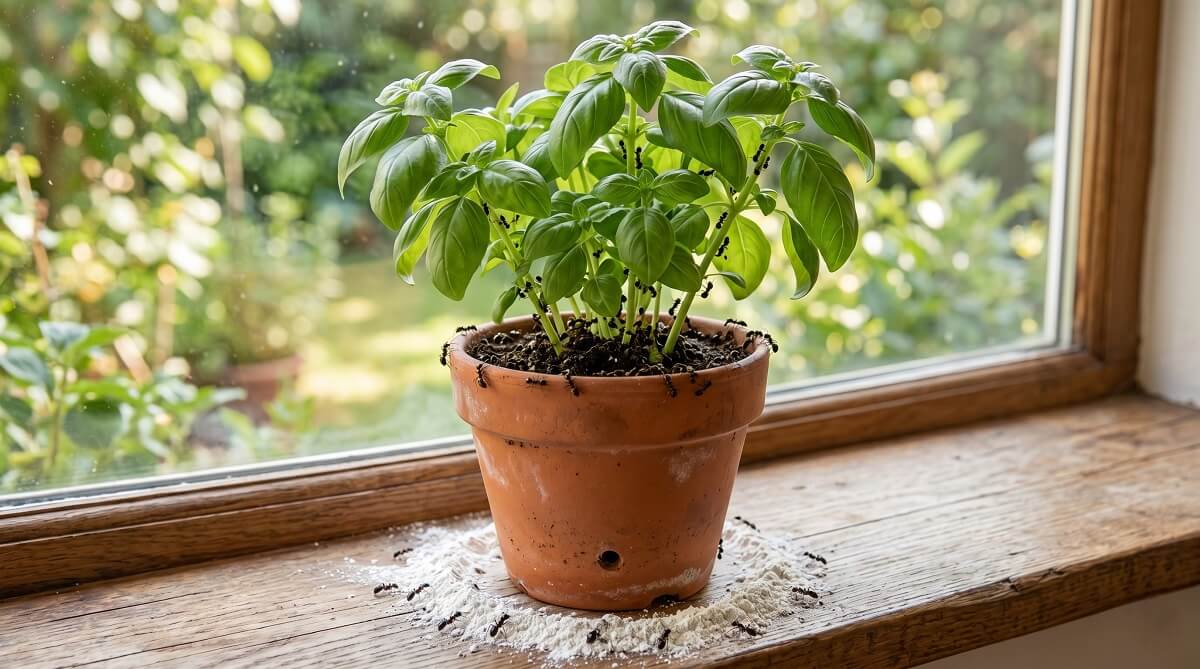
Ants in a potted plant are more of an annoyance than a crisis — they don’t chew on roots or eat leaves. What draws them in is usually something else: loose, dry potting mix makes ideal nesting ground, or another pest like aphids or mealybugs is producing the sweet honeydew ants love to feed on. Evict them, and if the colony keeps returning, look harder for the underlying cause.
The fastest chemical-free fix is the water submersion method — you submerge the whole container in a bucket of water and the colony evacuates within a few hours. For ongoing prevention, a ring of food-grade diatomaceous earth around the pot base keeps new scouts from moving in. Below, you’ll find five approaches ranked by speed, cost, and safety around edible plants and pets, so you can choose the right one for your situation. You’ll also find a if you want to dig into product comparisons beyond what’s covered here.
Which Removal Method Should You Use?
✅ Best For
- Fastest, chemical-free fix: Water submersion (free, works in 3–24 hours)
- Light indoor infestations: Insecticidal soap spray or soak
- Edible herbs and vegetables: Water submersion or food-grade diatomaceous earth
- Destroying the whole colony: Borax-based bait traps
- Ongoing prevention: Diatomaceous earth barrier + natural repellents
❌ Skip If
- Self-watering pots: Avoid soap soaking (soap residue can foul the reservoir); use bait traps placed near the container instead
- Pets or young children nearby: Keep bait traps out of reach; food-grade DE is the safer long-term barrier option
- Can’t bring pot outside: Bait traps placed along ant trails are your best indoor-only option
Why Ants Move Into Potted Plants
Ants end up in containers for a handful of practical reasons — none of which have anything to do with your plant being unhealthy or poorly cared for.
The Potting Mix Is Dry and Loose
Ant colonies need loose, well-aerated material to dig their tunnels. A container sitting in dry growing medium — especially one that has become hydrophobic and started pulling away from the pot walls — is prime real estate. The drainage holes in the bottom are a convenient front door.
Another Pest Is Producing Honeydew
According to Gardening Know How, ants are often drawn to houseplants not by the plant itself, but by aphids, scale insects, mealybugs, or whiteflies feeding on it. These pests excrete honeydew — a sticky, sugary waste — that ants actively farm. If you’re seeing ants on a plant but can’t find evidence of a nest in the soil, check the undersides of leaves and stems for soft-bodied pests before doing anything else.
You Brought an Infested Container Indoors
Outdoor pots left on patios or in the garden are constantly exposed to foraging scouts. A colony can move into the potting mix in a matter of days, especially in warm weather. Any time you bring a container inside — seasonally or for an event — check the drainage holes and soil surface for ant activity first.
Ants don’t feed on plant roots or foliage. In most cases, . Where ants do cause problems over time is by tunneling through the growing medium, creating air pockets around roots that dry them out faster than normal.
5 Ways to Get Ants Out of Potted Plants
Method 1: Water Submersion — Free, Chemical-Free, and Surprisingly Effective
This is the technique Greg Alder, a food garden educator in Southern California, has used successfully on avocados, coffee plants, and other container specimens — including those with oxygen-sensitive root systems. The logic is simple: ants can’t survive underwater, so flooding the pot forces the entire colony to evacuate.
How to do it:
- Find a bucket, storage tote, or basin larger than your pot.
- Lower the container in and fill with water until the water line sits above the surface of the potting mix.
- Leave it submerged until ants stop streaming out — typically 3 to 4 hours for small colonies, up to 12 to 24 hours for larger ones.
- Lift the pot out and let it drain near another plant to avoid wasting the water.
The ants won’t drown — they’ll migrate out and find a new home. The treatment also gives your plant a thorough, even soaking, which is a bonus if you’ve been struggling with dry spots in the growing medium.
Large pot workaround: If your container won’t fit in a bucket, line a large storage tote or trash can with a heavy-duty plastic bag and use that as your vessel. Several gardeners have confirmed this approach works well for containers up to 25 gallons.
Method 2: Insecticidal Soap Soak
The UC IPM program at the University of California recommends this approach for ants nesting in container soil: remove the pot from the building first, then submerge it in a diluted insecticidal soap solution for at least 20 minutes.
Dilution: 1 to 2 tablespoons of liquid insecticidal soap per 1 quart (946 mL) of water. The soil surface should be just covered by the solution.
You can also apply this as a spray — mist the soil surface and the base of the pot to kill ants on contact. For heavy infestations, the full soak is more reliable than spraying alone.
Soap type note: True insecticidal soap (like Safer Brand) is formulated to break down quickly and is less likely to leave residue that harms beneficial soil microbes. Plain dish soap works in a pinch, but use it sparingly — repeated applications can disrupt soil structure over time.
Method 3: Food-Grade Diatomaceous Earth
Diatomaceous earth (DE) is a powder made from the fossilized shells of tiny aquatic organisms. It works mechanically, not chemically — microscopic sharp edges pierce the exoskeletons of ants and other crawling insects, causing them to dehydrate. According to the National Pesticide Information Center (NPIC), the FDA classifies food-grade DE as “Generally Recognized as Safe,” and over 150 products are registered for use in gardens, farms, and pet kennels.
How to apply: Sprinkle a visible ring of food-grade DE around the base of the pot and lightly dust the top of the soil. Reapply after watering or rain, as wet DE loses its effectiveness until it dries out again.
Safety: Food-grade DE is non-toxic to plants, mammals, and birds — a solid choice for edible herbs and vegetables. Wear a dust mask during application; the fine particles can irritate the airway if inhaled in quantity.
Harris Food Grade Diatomaceous Earth is a widely available option — find it on Amazon in sizes from a half-pound to 10 lb. It’s OMRI-listed (approved for organic use). Check current pricing before ordering.
Method 4: Borax Bait Traps (Best for Eliminating the Colony)
To destroy the colony at the source rather than just evict it, borax-based bait traps are the most dependable tool for home gardeners. Worker ants carry the slow-acting boric acid back to the nest, where it eventually reaches and kills the queen. For , the how-to section on ChubbytIps covers the key trade-offs.
Placement: Set traps along the visible ant trails leading to and from the pot. For outdoor containers, place stations near the pot base. For indoor plants, UC IPM advises using bait indoors only for serious invasions — otherwise you risk drawing more ants in from outside.
TERRO T300B Liquid Ant Bait Stations (12-count, ~$13.76 as of March 2026) are the top-selling option on Amazon and among the most field-tested consumer products available. The liquid bait is pre-filled and ready to use — just break the tab and set the station.
Caution: Keep bait stations away from pets and children. Don’t place them directly in the potting mix — the goal is to intercept ants on their trail, not add borax to your growing medium. Borax is low toxicity but not approved for direct application to soil in edible-plant containers.
Method 5: Natural Repellents (Ongoing Prevention)
For mild problems or as a follow-up layer of defense, several common pantry and garden items deter ants from setting up shop:
- Coffee grounds: Scatter fresh grounds on the soil surface. Ants dislike the smell. Refresh after watering and don’t pile them thickly — a heavy layer can compact and develop mold.
- Cinnamon: Sprinkle around the pot base and on the soil rim. Ground cinnamon disrupts ant scent trails. Reapply every week or after rain.
- Citrus peel or diluted citrus oil: The natural oils in citrus rind are a mild deterrent. Lay fresh peel on the soil surface, or dilute a few drops of citrus essential oil in water and spray the exterior of the pot and saucer.
- Peppermint oil: Dilute with water (5–10 drops per cup) and spray around the pot exterior. Keep oils off the leaves directly — undiluted essential oils can burn plant foliage.
These options are gentle, pet-safe, and appropriate for edible plants. They work best as a first line of defense or as maintenance after you’ve already cleared an invasion — not as a standalone fix for a large, established colony.
Ant Removal Methods at a Glance
| Method | Speed | Avg. Cost | Pet-Safe | Safe for Edibles | Kills Colony? |
|---|---|---|---|---|---|
| Water submersion | 3–24 hours | Free | Yes | Yes | No (evicts) |
| Insecticidal soap soak | 20–60 min | ~$5–10 | Check label | Check label | Partial |
| Diatomaceous earth | Days (barrier) | ~$10–20 | Yes (dry) | Yes (food-grade) | Partial |
| Borax bait traps | 3–7 days | ~$7–14 | Keep away | Not in soil | Yes |
| Natural repellents | Ongoing | $0–5 | Yes | Yes | No |
Costs are approximate as of March 2026. Check current prices before purchasing.
How to Stop Ants From Returning
A one-time treatment often buys you a few weeks of peace, but without addressing what drew ants in originally, a new colony will move in. Here’s how to make your pots a long-term no-go zone:
Deal With Aphids and Other Honeydew Producers
This is the most important step if ants keep returning to the same plant. Inspect the undersides of leaves for aphids (small, soft-bodied, usually clustered), scale (brown bumps along stems), or mealybugs (white cottony masses). removes the food source that was drawing ants in, which is the only lasting fix.
Keep Saucers Dry
Standing water in pot saucers doesn’t attract ants directly, but it encourages mold and can make the soil surface hospitable for other pests. A wet saucer can also wick moisture back into the growing medium and create favorable nesting conditions. Empty saucers after watering.
Create a Physical Barrier
Place a ring of food-grade DE around the pot base on a dry surface. For outdoor pots on patios, you can also use — short elevating stands — combined with a shallow water moat (a saucer filled with water and a drop of dish soap). Ants won’t cross the soapy water surface.
Inspect New Plants Before Bringing Them Inside
Check the drainage holes, the soil surface, and the underside of leaves on any plant before moving it indoors. Argentine ants and fire ants can establish a satellite colony inside a container in less than a week when conditions are right. Browse more for help identifying and managing common houseplant pests.
Frequently Asked Questions
Are ants harmful to potted plants?
Ants don’t eat roots or leaves, so they won’t directly damage a plant. Over time, heavy tunneling can create air pockets around the roots that dry them out faster, but this is a slow process. The bigger concern is that ants often signal the presence of aphids, scale, or mealybugs — sap-sucking pests that do harm the plant while producing the honeydew ants are after.
How long do I need to soak a pot to remove ants?
Three to four hours typically clears a small colony. For a large or well-established colony, leave the container submerged for 12 to 24 hours. Keep the water level above the soil surface the entire time. Once you stop seeing ants emerging, you’re done.
What can I put on potted plants to keep ants away?
Food-grade diatomaceous earth sprinkled on the soil surface and around the pot base is one of the most reliable ongoing deterrents. Coffee grounds and cinnamon work too, though both need refreshing after watering. For a physical barrier, a ring of DE on a dry surface around the exterior of the container is very effective.
Is diatomaceous earth safe for plants and pets?
Food-grade DE is non-toxic to plants, mammals, and birds — the FDA classifies it as “Generally Recognized as Safe.” It works mechanically, not chemically, so it doesn’t leach into soil or harm plant roots. Keep pets away during application because inhaling fine DE dust in large quantities can irritate the airway. Once it settles, it’s fine.
Can I use TERRO ant bait near edible plants?
TERRO’s active ingredient is borax (sodium tetraborate). It’s low toxicity but not approved for direct application to soil in edible-plant containers. Place the bait stations near the container along ant trails — not in the potting mix itself — and keep them away from roots. The ants will find the bait regardless of where it’s placed on their trail.
Why do ants keep coming back to my pots?
Usually one of two reasons: there’s a pest producing honeydew on the plant (check for aphids, scale, or mealybugs), or the potting mix is dry and loose enough to make attractive nesting ground. Removing the colony without fixing the root cause means a new one will move in. Combine treatment with a DE barrier and a pest inspection for lasting results.
My pot is too big to submerge. What are my options?
Line a large storage tote or a heavy-duty trash can with a thick plastic bag and use that as your submersion vessel. Several gardeners have had success with this approach for containers up to about 25 gallons. If submersion isn’t practical at any size, borax bait traps placed along the ant trail leading to the pot will destroy the colony over three to seven days.
Do coffee grounds keep ants away from potted plants?
Fresh coffee grounds do deter ants — they dislike the smell. The effect is real but temporary. Refresh the grounds after each watering, and don’t build up a thick layer, as that can compact the soil surface and encourage mold. Coffee grounds work better as ongoing maintenance than as an emergency fix for a large colony.
Ready to Take Action?
For a product-based fix, check current prices on TERRO Liquid Ant Bait Stations on Amazon — the top-selling consumer option for eliminating colonies. For a chemical-free barrier, Harris Food-Grade Diatomaceous Earth on Amazon is OMRI-listed and suitable for both edible and ornamental containers.
For most home gardeners, the water submersion technique handles a fresh infestation for free in an afternoon. Pair it with a DE barrier and a pest inspection, and you should stay ant-free going forward.
