


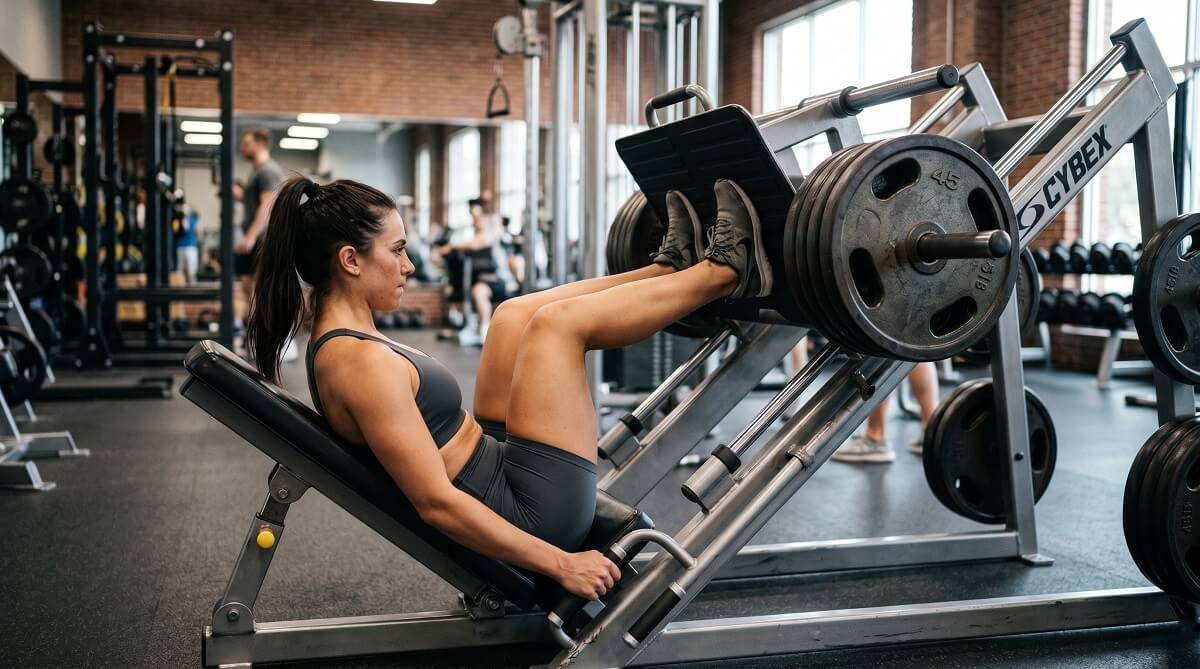
Yes, the leg press works your glutes — but not automatically. Out of the box, the machine defaults to a quad-dominant movement. The standard shoulder-width, mid-platform foot position puts most of the load on your quadriceps. If you step on without adjusting, your glutes are along for the ride but not doing much of the driving.
A few targeted adjustments change that picture. Placing your feet higher on the platform and slightly wider than shoulder-width, then pressing through your heels rather than your toes, shifts a meaningful portion of the load onto the gluteus maximus. Research on leg press EMG activity found that at higher intensities, a high foot placement produced roughly 42% more gluteus maximus activation compared to a low foot position, according to a systematic review published in the National Institutes of Health’s PMC database.
That said, if building glutes is your main training priority, the leg press works best as a complement to hip-dominant exercises like hip thrusts and Romanian deadlifts. Browse our fitness how-to guides for more on building a complete lower-body program. For adding volume, relieving spinal loading, and isolating one leg at a time, the leg press earns its spot on leg day.
When to Use the Leg Press for Glutes (and When to Skip It)
✅ Good Choice If:
- You want to load the glutes without compressing your spine
- Back pain or mobility issues make heavy squatting uncomfortable
- You want to correct a left-right strength imbalance using single-leg presses
- You’re newer to training and want a guided movement pattern to build from
- You need extra glute volume after compound lifts
❌ Skip It or Supplement It If:
- Maximum glute hypertrophy is your primary goal — hip thrusts, Bulgarian split squats, and Romanian deadlifts are more efficient
- You want core strength and stability training alongside leg work — squats are the better option
- You don’t have access to a leg press machine — resistance band squats and lunges cover the same territory
What Muscles Does the Leg Press Actually Work?
According to ACE Fitness’s exercise library, the seated leg press targets the glutes, quadriceps, and hamstrings as primary movers, with the abdominal muscles providing spinal stabilization throughout.
Primary Muscles
- Quadriceps — the dominant muscle in standard foot placement; responsible for knee extension during the push
- Gluteus maximus — the largest glute muscle, responsible for hip extension; recruited more as foot placement moves higher
- Hamstrings — secondary role in standard placement; contribution increases with higher foot position
Supporting Muscles
- Calves (gastrocnemius) — activated when pushing through the full foot; less so when focusing on heel drive
- Gluteus medius and minimus — the smaller glute muscles that stabilize the hips and assist with hip abduction; engaged when toes are turned outward during the press
The gluteal muscle group is made up of three distinct muscles: the gluteus maximus (the largest and most visible), the gluteus medius, and the gluteus minimus. The maximus handles hip extension — driving your thigh backward — which is exactly what happens at the bottom of a leg press when you push back up. The medius and minimus stabilize the pelvis; turning your toes outward adds abduction to the movement, which recruits them more actively.
How Much Do Leg Presses Actually Work the Glutes?
Honest answer: in standard form, the leg press is mostly a quad exercise. The more useful question is what happens when you optimize for glutes.
A 2008 EMG study by Da Silva et al., analyzed as part of a systematic review on leg press muscle activation, measured gluteus maximus activity across different foot positions at both 40% and 80% of one-rep max. At higher loads (80% 1RM), participants using a high foot position showed approximately 115% normalized RMS gluteus maximus activity, compared to approximately 81% for a low foot position — a difference of around 42%. At lower intensities, the gap essentially disappeared.
What this means practically: foot placement matters, and it matters more as the weight increases. If you’re doing leg press with light loads for high reps, the glute recruitment difference between high and low position will be small. Push closer to your working capacity and position your feet correctly, and you’ll feel the difference in your glutes during the rep.
For context, a 2018 study cited by Healthline (Rossi et al.) found that both back squats and leg presses produced equivalent lower-body strength gains over a 10-week program. Neither exercise is inherently superior — what changes the outcome is how consistently and progressively you train with either one.
How to Set Up the Leg Press to Target Your Glutes
The setup is where most people leave glute gains on the table. Getting this right takes about 30 seconds before your first set.
Foot Placement: The Most Important Variable
Standard stance — shoulder-width feet at the middle of the platform — is fine for general quad training. For glute focus, three adjustments work together:
- Move your feet higher — aim for the upper third to two-thirds of the platform. This increases how far your hips flex at the bottom of each rep, which directly stretches and loads the gluteus maximus.
- Widen your stance slightly — a bit wider than shoulder-width opens up the hips and creates a deeper stretch in the glutes at the bottom of the movement.
- Turn toes outward 15–30 degrees — this adds hip abduction to the movement, bringing the gluteus medius and outer glute into play alongside the maximus.
Two practical limits to stay within: keep your feet no higher than two-thirds up the platform (past that, you stress the lower back), and don’t point your toes more than 45 degrees outward (past that, knee tracking becomes problematic).
Pressing Cues That Change What You Feel
- Drive through your heels. When you push with your toes, the calves and knees absorb more of the load. ACE Fitness explicitly cues “heels flat against the plate” for this reason, and Anytime Fitness coaches describe heel drive as a direct way to “focus the tension on your glutes.” Feel your heel press into the platform at the start of each rep.
- Pause at the bottom for 1–2 seconds. Pausing eliminates the stretch reflex and any momentum you’ve built up. Without momentum, your glutes have to generate the force to push the platform back up from a dead stop. Most people find this is where they actually feel the glutes working.
- Lower to 90 degrees or slightly deeper. ACE Fitness recommends a roughly 90-degree knee bend as the starting position, which translates to a solid working depth. Going too shallow reduces the glute stretch; going past where your lower back starts to round off the seat is too far.
Machine Setup Checklist
- Adjust the seat position so your lower back and pelvis stay pressed flat against the pad at the bottom of each rep
- Don’t lock your knees at the top — leave a slight bend to protect the joint
- Keep your hands on the side handles, not pushing off your thighs, for proper muscle isolation
3 Techniques to Get More Glute Activation Per Rep
Once your foot placement and pressing cues are dialed in, these three additions can push glute recruitment further.
1. Pause Reps
Lower the platform to your bottom position and hold for a full count of two before driving back up. This removes elastic rebound from the equation and forces the glutes to initiate the movement from scratch. Use this with moderate weight — it’s harder than it sounds, and you’ll likely need to drop 10–20% off your working load when you first add it.
2. Add a Resistance Band Around Your Thighs
A mini loop band (also called a glute loop or hip band) placed around your mid-thighs creates continuous tension on your outer gluteal muscles and abductors throughout the entire movement. This activates the gluteus medius in a way that standard leg press doesn’t address. You can find options like the ProsourceFit Fabric Loop Resistance Bands on Amazon — check current pricing and availability there. Browse more fitness accessories reviewed on ChubbytIps for other training tools worth adding to your routine.
3. Single-Leg Presses
One leg at a time removes the ability of a stronger side to compensate for a weaker one. Each glute gets isolated, and the range of motion per rep tends to increase naturally. Start at about 50–60% of what you’d use for two-leg pressing, and match reps equally on both sides. This is particularly useful if you’ve noticed one glute lagging behind the other.
Leg Press vs. Squat for Glute Development
Both movements work the same muscle groups — the debate is about how much and in what context. A 10-week study found both exercises produced equivalent lower-body strength gains. The practical differences come down to your setup and goals.
| Factor | Leg Press | Barbell Squat |
|---|---|---|
| Glute activation (standard form) | Moderate | Higher |
| Glute activation (optimized form) | Moderate–High | High |
| Spinal loading | Low — back is supported | Moderate–High |
| Core involvement | Minimal | Significant |
| Max weight achievable safely | Higher (machine-guided) | Lower (balance-limited) |
| Learning curve | Easy | Moderate — form matters |
| Good for back pain | ✅ Generally yes | ⚠️ Depends on type/severity |
| Good for beginners | ✅ Yes | ✅ With coaching |
| Strength gains over 10 weeks | Equivalent (Rossi 2018) | Equivalent (Rossi 2018) |
The practical takeaway: squats edge out leg press for raw glute activation because the free-weight movement demands greater hip flexion depth and involves more stabilizer recruitment. But leg press lets you handle more total load with less technical difficulty — and loading progressively over time is what drives muscle growth. Check our fitness buying guides for equipment recommendations if you’re building a home gym setup.
A Glute-Focused Leg Press Workout to Try
This session structure puts the glute-optimized pressing machine at the center and surrounds it with movements that address what it misses. According to Anytime Fitness certified coach Heather Berg, beginners should start with a weight they can control for 12–15 reps and gradually increase load over time as the body adapts — the principle of progressive overload applied consistently is what produces visible change.
- Warm-up: 5 minutes of light cardio + 2 sets of 15 glute bridges (activates the glutes before loading)
- A1 — High-Wide Leg Press: 4 sets × 10–12 reps (pause 1–2 seconds at the bottom of each rep)
- A2 — Single-Leg Leg Press: 3 sets × 8–10 reps per leg (match both sides)
- B1 — Hip Thrust: 3 sets × 12–15 reps (optional finisher; direct glute isolation)
- Cool-down: 5-minute stretch — hip flexors, glutes, hamstrings
For progressive overload on the leg press: once you can complete all reps with good form and the pause, add weight (typically 5–10 lbs) on the next session. Aim to train lower body 2–3 times per week with at least 48 hours between sessions to allow for muscle recovery.
When the Leg Press Isn’t Enough: Best Glute Exercises to Pair With It
The leg press is a solid supplementary movement, but it doesn’t replace glute-specific exercises for people focused on development. These are the four movements worth building your glute training around, with the leg press added for extra volume.
- Hip Thrust / Glute Bridge: The gold standard for gluteus maximus isolation. The hip extension pattern under load directly targets the glutes with minimal quad involvement. Barbell hip thrusts allow heavy progressive loading.
- Romanian Deadlift (RDL): Targets the glutes and hamstrings through a hip hinge. The stretch at the bottom of each rep creates significant glute tension. Start lighter than you think you need to — the hamstring stretch is deceptive.
- Bulgarian Split Squat: A single-leg squat variation that forces each glute to work independently. Harder on the ego than the leg press but more demanding for glute hypertrophy due to the range of motion and hip flexor stretch.
- Cable Kickback: Isolates the gluteus maximus through a range of motion the leg press doesn’t cover. Useful as a finishing movement after compound work.
Build your training week around hip thrusts and RDLs as the primary drivers. Use the leg press — with the technique adjustments covered in this article — for additional volume and quad/glute balance work. See our fitness gear reviews for equipment and accessory recommendations that support this kind of training.
Frequently Asked Questions
Does the leg press build glutes or just quads?
Both. In standard setup — shoulder-width feet at the mid-platform — the quads are the primary driver. Move your feet higher and wider, drive through your heels, and pause at the bottom, and glute recruitment increases meaningfully. ACE Fitness lists glutes as a primary muscle in the exercise, and EMG research confirms the foot-placement effect on gluteus maximus activation.
Where should I put my feet on the leg press for glutes?
High on the platform (upper third to two-thirds), slightly wider than shoulder-width, with toes turned out 15–30 degrees. Stay within those ranges — going higher than two-thirds of the platform or past 45 degrees toe rotation increases stress on the lower back and knees.
Should I push through my heels or toes on the leg press?
Heels. Pressing through your toes shifts tension toward your calves and anterior knee. Pressing through your heels keeps the load on your glutes and posterior chain. ACE Fitness specifically cues keeping heels flat against the plate throughout the movement.
Will the leg press make my glutes bigger?
It can contribute to glute hypertrophy, especially with consistent progressive overload over time. For maximum glute size, combine it with hip thrusts and Romanian deadlifts — exercises that load the glutes more directly across a fuller range of motion. The leg press alone, without those complements, will produce limited glute results for most people.
Is the leg press safe for people with lower back pain?
Generally yes — the machine supports your back and eliminates the spinal loading that makes barbell squats uncomfortable. Keep the foot placement within the two-thirds limit to avoid posterior pelvic tilt at the bottom, which is where lower back strain typically comes from on the leg press. If you have a specific injury, check with a physical therapist before loading the movement.
How much weight should I use on the leg press for glutes?
Start with a weight you can control through a full range of motion for 10–12 reps. Add 5–10 lbs when that becomes consistently easy. Heavier loads produce a more noticeable difference in glute activation between foot positions (the EMG difference between high and low foot placement is larger at 80% 1RM than at 40%), but form and depth matter more than max load.
How often should I leg press for glutes?
2–3 times per week is a solid target, with at least 48 hours between sessions. That frequency allows for progressive overload and adequate recovery. If you’re also doing hip thrusts and RDLs in the same week, distribute the training days so the glutes aren’t taxed every day.
Can beginners use the leg press to build glutes?
Yes — it’s one of the more beginner-friendly machines because it guides movement and doesn’t require balance or technical skill. The machine’s fixed range of motion makes it easier to learn form before moving to free-weight exercises. Browse beginner workout guides on ChubbytIps for more structured starting points.
Ready to add resistance bands for extra glute activation? Check current prices on loop bands on Amazon — they’re a low-cost addition that meaningfully changes how the leg press feels on your outer glutes. If you’re unsure how any of these technique adjustments translate to your specific machine setup, a 10-minute session with a certified personal trainer at your gym is worth the time.
