


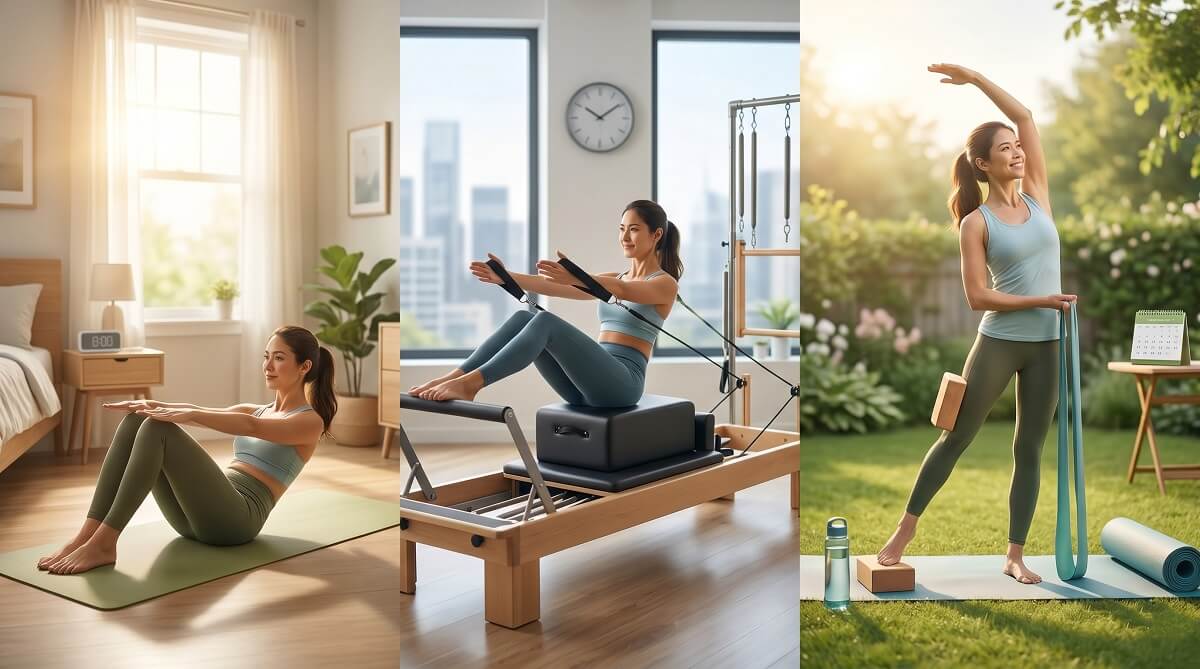
For most people, 2–3 Pilates sessions per week is the practical sweet spot. That number holds whether you’re brand new to the practice or have been at it for months. The frequency shifts based on what you’re after: weight loss benefits from 4–5 classes, injury rehab calls for 1–2, and if Pilates is your entire exercise routine, 3 sessions a week gives you enough volume to see real changes. If you’re combining it with running, lifting, or other training, 2 sessions can be plenty.
The deeper principle is that consistency beats volume. Joseph Pilates, who developed the method in the 1920s, put it plainly: “In 10 sessions you’ll feel the difference, in 20 you’ll see the difference, and in 30 you’ll have a whole new body.” That progression was built around practicing 3 times per week — not cramming sessions in back-to-back.
Below, you’ll find what the evidence actually says, what cadence makes sense for different goals, and sample weekly schedules you can drop into your real life — not a fantasy training calendar.
Who Should (and Shouldn’t) Prioritize More Frequent Practice
✅ Best For
- Complete beginners building their first movement foundation
- People adding Pilates alongside running, lifting, or other training
- Anyone recovering from injury or managing chronic back pain
- People who want better posture, core strength, and flexibility without high-impact training
- Those who need something that fits into a 45-minute window a few times a week
❌ Skip the “More Is Always Better” Approach If:
- You’re already training hard 5–6 days a week and stacking Pilates on top would push you over your recovery capacity
- You’re showing signs of overtraining: persistent soreness that doesn’t clear, declining performance, dreading classes
- Your schedule won’t realistically support more than 2 sessions — setting a 5x goal you won’t hit is more discouraging than a 2x goal you’ll nail every week
Pilates Frequency by Goal — Quick Reference
Before going deeper, here’s a practical starting point. Find your primary objective and use the number as your anchor. You can always adjust after 4–6 weeks of honest feedback from your body.
| Goal | Sessions per Week | Notes |
|---|---|---|
| General fitness & flexibility | 2–3x | Sustainable long-term; solid entry point for most people |
| Weight loss | 4–5x | Pair with cardio; Pilates alone has caloric limits |
| Strength & muscle tone | 3–4x | Add Reformer or resistance; body weight-only plateaus faster |
| Back pain / chronic pain | 2–3x starting | Research supports 2x/week as the effective threshold; see below |
| Athletic cross-training | 2–3x | Complements sport-specific training; don’t overlap recovery days |
| Injury rehab | 1–2x | Follow healthcare provider guidance; consistency over intensity |
| Stress relief / mental well-being | 2–3x | Even 1x delivers benefit; regularity matters most here |
For context: the CDC recommends adults get at least 150 minutes of moderate-intensity physical activity per week, plus two days of muscle-strengthening activity. Three 50-minute Pilates classes satisfies both the aerobic and the strengthening components of that guideline.
Starting Out: Why 2–3 Times a Week Is the Right Foundation
New practitioners often want to go hard from day one. That’s a reasonable impulse — but Pilates has a steeper neural learning curve than most people expect. You’re not just doing movements; you’re teaching your nervous system to recruit deep stabilizers (transverse abdominis, multifidus, pelvic floor muscles) that most people have never consciously activated. That neurological adaptation needs recovery time, not just muscle rest. If you’re also looking at home equipment to support your practice, .
The First Four Weeks
Classes 1–10 are about learning, not intensity. Focus on understanding how your spine positions in neutral, what it feels like to breathe laterally (into the ribs rather than the belly), and how to connect your core before you move your limbs. Getting this foundation right in the first four weeks pays dividends for years. Start with 2 sessions a week. Add a third in week 3 or 4 if you’re recovering well and the movements feel familiar.
What “Recovery” Actually Means Here
Rest isn’t just about sore muscles. After a Pilates class, your nervous system is integrating new movement patterns. That process continues for 24–48 hours. On your off days, a 15–20 minute gentle at-home session — YouTube, an app, or a sequence your instructor showed you — reinforces the patterns without adding load. These shorter at-home practices are underrated and most beginners skip them.
What the Research Shows
A 2023 umbrella review published in the Journal of Science and Medicine in Sport analyzed 27 systematic reviews and meta-analyses on Pilates and multiple health outcomes. Across multiple populations and conditions, regular Pilates training showed consistent positive effects on physical function, pain reduction, and quality of life. The key word throughout the literature is “regular” — studies uniformly used scheduled, recurring sessions rather than sporadic attendance.
Intermediate and Advanced: When to Step Up Your Frequency
Once you’ve been training consistently for 4–6 weeks, your body has built enough neuromuscular foundation to handle more volume. Here’s how to progress without burning out.
Intermediate (1–6 Months of Consistent Practice)
Move from 2–3 to 3–4 sessions a week. If you’ve been working exclusively on a mat, this is also the right time to introduce Reformer work, which uses spring-based resistance to create genuine progressive overload. You’ll notice faster recuperation between classes — that’s your signal that your body is adapting and can handle more. This stage is typically where strength and body composition changes become visible, not just felt.
Advanced (6+ Months)
Four to six sessions per week becomes achievable without overtraining — but only if you vary the effort level. Not every class needs to be your hardest. Experienced practitioners often mix challenging Reformer work, medium-intensity mat training, and lighter restoration-focused sessions through the week. The objective is cumulative volume without cumulative fatigue.
Combining Pilates With Other Workouts
Most people don’t do Pilates in isolation. Here’s how to fit it into a broader training week without doubling up on recovery demands. For gear recommendations to support a mixed routine, .
The 3-2-1 Training Split
One structured approach that’s gained traction: 3 days of strength training, 2 days of Pilates, 1 day of cardio, and 2 rest days. This layout delivers strength stimulus, movement quality work, cardiovascular output, and genuine downtime. It’s particularly useful for people who want all three adaptations — muscle, mobility, and endurance — without overloading any single system.
Pilates + Running or Cycling
Two Pilates classes per week as a complement to running or cycling works well. The practice addresses the hip mobility, lateral hip stability, and breathing mechanics that running often neglects. Schedule your Pilates on easy or rest days from running — not the day before a hard interval session, when your stabilizers need to be fresh.
Pilates + Weight Training
Two to three Pilates sessions alongside 3 days of lifting gives you dedicated mobility and core stability work without competing too directly with your strength days. Pilates can function as a warm-up sequence, a cool-down mobility session, or a standalone day. The main thing to avoid: heavy Reformer work that fatigues your stabilizers immediately before a deadlift or squat day.
Mat Pilates vs. Reformer: Does Your Equipment Change the Frequency?
Slightly, yes. And the answer matters for your wallet too.
Mat Pilates
Mat-based training primarily uses body weight and smaller resistance props — rings, bands, light weights. The recovery demand is lower than Reformer work, which means you can practice mat Pilates more frequently, including on active rest days from other training. A 20-minute mat sequence on a day off from the gym is almost always a net positive.
Reformer Pilates
The spring-based resistance on a Reformer creates genuine eccentric muscle loading — the same mechanism behind post-lifting soreness. Treat intense Reformer classes the way you’d treat a moderate strength day: allow 24–48 hours before working the same muscle groups again. This is also one reason most people realistically attend 2–3 times per week rather than daily.
Group Reformer classes in the USA typically run $20–$60 per session, with unlimited monthly memberships ranging from around $180–$350 depending on location. In major metros like New York or Los Angeles, expect the higher end of both ranges. That cost reality naturally limits how often most people attend — which is fine, since 2–3 Reformer sessions a week is enough to see meaningful progress.
Pilates for Back Pain: What the Research Actually Says About Frequency
Back pain is one of the most common reasons people come to Pilates, and there’s solid clinical evidence to guide your frequency decisions here.
A network meta-analysis in the Journal of Orthopaedic & Sports Physical Therapy (2022) found that Pilates ranked highest among exercise interventions for reducing chronic low back pain, with a 93% likelihood for pain reduction and 98% for disability reduction compared with other exercise options. Those are strong numbers for any single modality.
On the specific frequency question, a randomized controlled trial by Miyamoto et al. (2016) compared 1x, 2x, and 3x per week Pilates programs for chronic low back pain over 6 weeks. The finding: 2 sessions per week produced clinically meaningful improvement. Three sessions per week did not deliver meaningfully better outcomes for either pain or disability. You don’t need to attend three times a week to get the back-pain benefit; twice is enough.
Start with 2 gentle, instructor-led classes per week. As discomfort decreases and function improves, you can add a third session or supplement with shorter at-home mat work. With acute pain or a specific diagnosis, get clearance from a healthcare provider before starting any exercise program.
Signs You’re Doing Too Much — or Not Enough
Too Much Pilates
- Muscle soreness that doesn’t clear between classes (not the “I worked hard” kind — the kind that accumulates session over session)
- Movements that felt manageable last week feel harder this week — declining form quality is a reliable early signal
- You’re dreading classes rather than looking forward to them
- Sleep disruption or persistent fatigue without another obvious explanation
- Nagging discomfort or minor strains in unexpected areas: hip flexor, lower back, shoulder
Not Enough Pilates
- Still confused by basic instructor cuing after 8+ weeks of sporadic attendance
- No perceptible change in range of motion, core awareness, or posture after two months
- You’re attending once every 10–14 days and calling it a regular practice
How to Adjust
If you’re overdoing it, cut one session per week and replace it with a rest day or a 20-minute walk. Don’t compensate by making remaining classes harder — that defeats the purpose. If you’re not attending enough, commit to one additional session per week for 30 days. Don’t overthink it; just show up one more time. Reassess after the month.
Sample Weekly Pilates Schedules
These are starting templates, not prescriptions. Each session can run 20–60 minutes depending on your available time — even a focused 20-minute class delivers real benefit when practiced with consistency.
Schedule A: Beginner (2 Studio + 1 At-Home)
- Monday: 45-min mat class at studio
- Thursday: 45-min mat class at studio
- Saturday: 15–20 min at-home mat practice (app or YouTube)
- Other days: walk, rest, or light movement
Schedule B: General Fitness (3 Pilates + 2 Cardio)
- Monday: Reformer Pilates (45 min)
- Wednesday: 30-min run or bike ride
- Thursday: Mat Pilates (45 min)
- Saturday: Reformer Pilates (45 min)
- Sunday: 30-min walk or easy cardio
- Tuesday/Friday: rest or gentle movement
Schedule C: The 3-2-1 Split (Strength + Pilates + Cardio)
- Monday/Wednesday/Friday: Strength training
- Tuesday/Thursday: Pilates (alternate mat and Reformer)
- Saturday: Cardio (run, cycle, or swim)
- Sunday: Full rest
Schedule D: Daily Gentle (Pain Management or Active Recovery)
- Monday–Friday: 20-min gentle mat Pilates
- Saturday: Longer 45-min class (studio or app)
- Sunday: Complete rest
Frequently Asked Questions
How often should I do Pilates as a beginner?
Start with 2 classes per week and add a third in weeks 3–4 if you’re recuperating well. The learning curve in Pilates is real — your nervous system is building new motor patterns, not just your muscles getting stronger. Two sessions weekly gives you enough repetition to progress without overwhelming your body’s adaptation capacity. Browse for more on starting a new training routine.
Is it OK to do Pilates every day?
Yes, with one condition: vary the intensity. Daily practice at high effort leads to cumulative fatigue, especially with Reformer work. If you want to train daily, alternate challenging sessions with shorter, gentler mat work. Many people do 20-minute restorative or flexibility-focused sessions on what would otherwise be off days — that’s a reasonable approach as long as your performance in harder classes doesn’t decline.
How long does it take to see results from Pilates?
Most people notice a shift in body awareness and posture within the first 2–4 weeks of consistent training. Visible changes in muscle tone and strength typically show up around 6–8 weeks. Meaningful changes in body composition generally require 3+ months of 3x/week practice combined with appropriate nutrition. The Joseph Pilates framing — feel it at 10 sessions, see it at 20, new body at 30 — roughly aligns with that timeline if you’re attending 3 times per week.
Can Pilates help with back pain, and how often should I practice for that?
Pilates is one of the most evidence-supported exercise approaches for chronic low back pain. Clinical research comparing different frequencies found that 2 classes per week produces meaningful improvement — and adding a third session didn’t accelerate results significantly. Start twice a week, keep early sessions supervised by a qualified instructor, and let your pain response guide progression.
Is 3 times a week enough for Pilates?
For most objectives, yes. Three sessions per week provides enough stimulus for solid improvements in strength, flexibility, and core function. It also satisfies the CDC’s muscle-strengthening guideline of at least 2 days per week of resistance work. If your aim is advanced strength or rapid flexibility gains, you might eventually move to 4x, but 3x is a reliable long-term practice cadence.
Should I do Pilates on rest days?
A gentle, low-effort mat session on a rest day from other training — 15–20 minutes of stretching and light core work — is generally fine and can support recuperation. What you want to sidestep is a hard Reformer class the day before a physically demanding workout. The distinction matters: Pilates as active recovery is different from Pilates as a training session.
Can Pilates replace my regular gym workouts?
Pilates can serve as your primary strength training, particularly if you incorporate Reformer work with progressive resistance. However, Pilates alone doesn’t deliver the same cardiovascular stimulus as running, cycling, or HIIT. For overall fitness, pair Pilates with some form of cardio rather than dropping it entirely. If pure strength gains are the aim, traditional weightlifting will outperform Pilates at lower frequency — but Pilates complements lifting better than almost any other modality.
How long should each Pilates session be?
The standard studio class runs 45–60 minutes — appropriate for most training objectives. Short on time? Twenty to thirty minutes of genuinely focused work delivers real benefit. A sharp 20-minute session with correct form and full attention outperforms a distracted 60-minute one. At-home sessions on the shorter end work well for beginners supplementing studio classes.
Ready to find the right Pilates schedule for your actual week? Check out for more on building training routines that stick, or browse if you’re setting up a home mat practice.
