


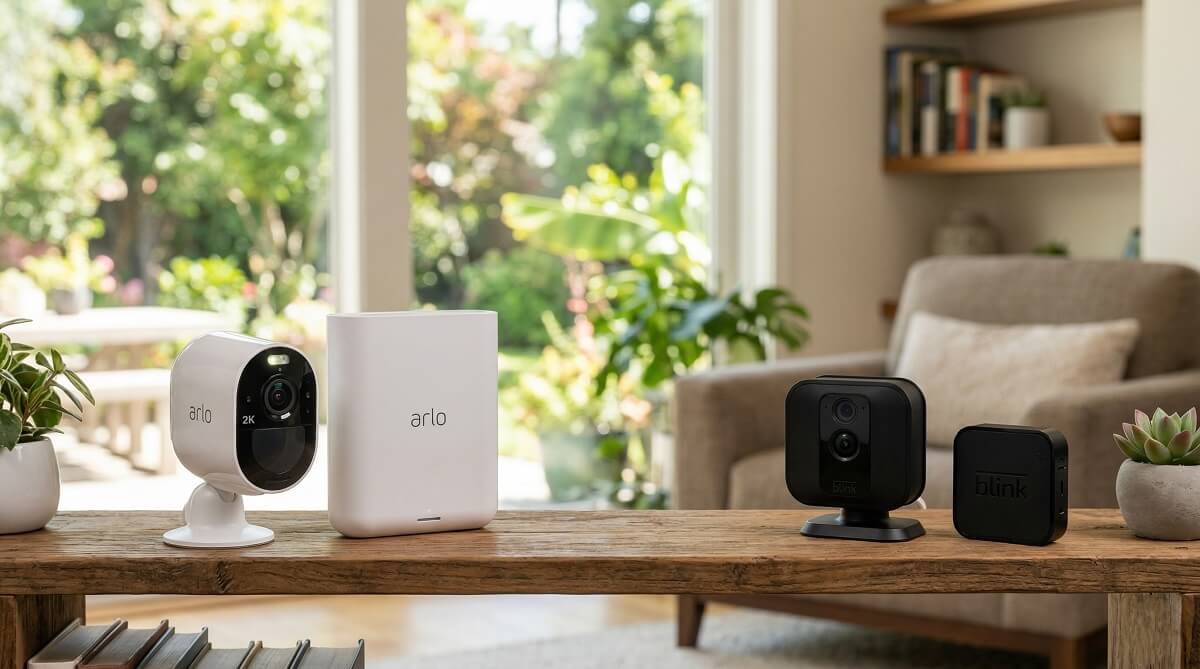
If you only want the short answer: Arlo is better for video quality and smart home features; Blink is better for your wallet and your battery anxiety. Arlo cameras shoot up to 4K and connect with Apple HomeKit, Google Home, and SmartThings. Blink caps out at 1080p and plays nicely with Alexa — and almost nothing else. But Blink’s outdoor cameras run for up to two years on a pair of AA batteries, and a starter system costs a fraction of what you’d spend on Arlo.
Both systems are DIY-friendly, require no contracts, and give you live view and motion alerts for free — no subscription required. The subscription unlocks cloud storage and AI detection, but neither forces you to pay monthly just to use the unit. That alone puts them ahead of many competitors. See our full home security buying guide for broader context if you’re just starting your research.
The choice between Arlo and Blink usually comes down to two questions: How much do you want to spend? And how often are you willing to change batteries? Read on and we’ll walk through every meaningful difference so you can land on the right system for your setup.
Quick Decision Guide — Arlo or Blink?
✅ Choose Arlo If You:
- Want 2K or 4K video resolution — Blink tops out at 1080p
- Use Apple HomeKit, Google Home, or Samsung SmartThings
- Want optional 24/7 professional monitoring ($24.99/month)
- Are building a layered system with sensors and cameras, not just cameras
- Need a camera that works on 4G LTE when your Wi-Fi goes down (Arlo Go 2)
❌ Stick With Blink If You:
- Want the lowest upfront cost — Blink cameras start around $35
- Need batteries to last — Blink outdoor cameras run up to two years per charge
- Already run an Amazon Alexa household
- Only need basic motion alerts and don’t want to pay monthly for features
- Are buying multiple cameras and want to stretch your budget further
Arlo vs Blink: Side-by-Side Comparison
Here’s how the two brands stack up across the specs that matter most for everyday home security.
| Feature | Arlo (Pro 5S 2K) | Blink (Outdoor 4) |
|---|---|---|
| Video Resolution | 2K HDR (4K on Ultra 2) | 1080p HD |
| Field of View | 160° | 143° diagonal |
| Night Vision | Color (integrated spotlight) | Infrared only |
| Battery Life (wireless) | ~3–6 months | Up to 2 years |
| Starting Camera Price | ~$99.99 (check current pricing) | ~$99.99 with Sync Module 2 |
| Free Tier | Live view + motion alerts | Live view + motion alerts |
| Cheapest Cloud Plan | $7.99/mo (1 camera, annual billing) | $3.99/mo per camera |
| Cloud Storage | 30 days | 60 days |
| AI Detection | People, animals, vehicles, packages | People only (no vehicle/package) |
| Smart Home Platforms | Alexa, Google, HomeKit, SmartThings, IFTTT | Alexa, IFTTT only |
| Pro Monitoring | Yes ($24.99/mo) | No |
| Local Storage | Via Arlo SmartHub | Via Sync Module 2 + USB drive |
Prices as of March 2026. Check current pricing before purchasing — both brands run frequent sales.
Camera Quality and Video Resolution
Arlo’s Advantage: 2K, 4K, and Color Night Vision
Arlo’s Pro 5S 2K shoots 2K HDR footage with a 160° field of view, 12x digital zoom, and color night vision courtesy of an integrated spotlight. Step up to the Arlo Ultra 2 and you get full 4K resolution — something Blink doesn’t offer at any price point. If you’ve ever squinted at a grainy clip trying to read a license plate or identify a face, the resolution difference becomes very real, very fast.
Color night vision is worth singling out. Arlo’s spotlight floods a scene with light and captures footage in full color, making it far easier to describe what you saw after the fact. A gray blob in infrared is much less useful than a clear image of a red jacket. See how Arlo models compare in our full reviews section.
Blink’s Approach: 1080p That Gets the Job Done
Blink’s Outdoor 4 tops out at 1080p HD with a 143° diagonal field of view and infrared night vision. For most porch, driveway, or backyard monitoring, 1080p is plenty — you can identify a person and read most details clearly. According to Tom’s Guide’s hands-on review of the Blink Outdoor 4, the camera earns a 4 out of 5 rating with the wider field of view (up from 110° in the previous gen) called out as a meaningful upgrade.
What you won’t get with Blink: color night vision, 4K, or optical zoom. If your primary concern is “did something move near my door,” Blink delivers. If you need to zoom in and confirm it was your neighbor’s car and not a stranger’s, Arlo’s sharper image and zoom help.
Battery Life — The Biggest Practical Difference
This is where Blink wins cleanly, and the gap is substantial. According to Blink’s official tech specs, the Outdoor 4 runs on two standard AA 1.5V lithium batteries for up to two years under default settings. Arlo’s wireless cameras average three to six months on a charge — and that’s under normal use.
The math matters if you’re mounting cameras in awkward spots or hard-to-reach locations. With Blink, you’re climbing a ladder maybe once every two years. With Arlo, you might be doing it every few months — and you’ll need the proprietary Arlo rechargeable battery pack rather than a quick trip to a convenience store.
Blink achieves its battery life by limiting when the device runs: it records only on motion, keeps clips short, and offloads the Wi-Fi heavy lifting to the Sync Module 2. That’s a reasonable trade-off for most users. Arlo’s approach gives you always-on connectivity options and faster response, but your batteries pay the price. Browse battery and power accessories for security cameras.
Subscription Plans and Cloud Storage
Both systems work without a paid plan — you’ll get live view and motion alerts for free. But if you want recorded clips saved to the cloud, you’ll need a subscription. Here’s how the plans compare.
Arlo Secure Plans (as of March 2026)
According to Arlo’s official subscription page, plans break down as follows:
- Free: Live view, motion alerts, no cloud recording
- Arlo Secure (1 camera): $7.99/month billed annually (or $9.99/month billed monthly) — 30-day cloud storage, AI smart detection, activity zones
- Arlo Secure (unlimited cameras): $17.99/month annually (or $19.99/month) — same features, all cameras covered
- Arlo Secure Premium: $24.99/month annually (or $29.99/month) — adds 24/7 professional monitoring and emergency dispatch
Blink Subscription Plans (updated October 2025)
Per Blink’s official support page, plan pricing increased in October 2025:
- Free: Live view, motion alerts, no cloud recording
- Basic Plan: $3.99/month per camera ($39.99/year) — 60-day cloud storage, person detection
- Plus Plan: $11.99/month for unlimited cameras at one location ($119.99/year) — 60-day cloud storage, lifetime camera warranty
Can You Skip the Subscription Entirely?
Yes — for both brands. Both offer local storage as an alternative. Blink stores recordings on a USB drive plugged into the Sync Module 2 (sold separately for around $35). Arlo offers local storage through its SmartHub. If you’re trying to avoid monthly fees altogether, local storage is a workable option with either system.
One thing to notice: Blink gives you 60 days of cloud history even on its cheapest plan, while Arlo’s paid tiers only go back 30 days. For most people, 30 days is enough — but if you travel for weeks at a time and want a longer lookback window, Blink has the edge here.
Smart Home Compatibility
| Platform | Arlo | Blink |
|---|---|---|
| Amazon Alexa | ✅ | ✅ |
| Google Home / Assistant | ✅ | ❌ |
| Apple HomeKit | ✅ | ❌ |
| Samsung SmartThings | ✅ | ❌ |
| IFTTT | ✅ | ✅ |
Arlo supports five major smart home platforms; Blink supports two. Blink is an Amazon product, so its deep Alexa integration makes sense — but if your home runs on Google or Apple, Blink is a dead end. Asking Alexa to show your Blink camera on an Echo Show works great. Asking Google Nest Hub to do the same? Not possible with Blink.
If you’re invested in Apple Home, Arlo is one of the few security camera brands with solid HomeKit support. That’s a genuine differentiator for iPhone households where Siri automations and Apple TV hubs are part of the setup. See our guide to setting up smart home security automations.
What You’ll Pay Upfront
Camera prices shift frequently — both brands run regular sales — but the general gap is consistent. Blink is substantially cheaper at every tier. According to Reviews.org’s head-to-head analysis, Arlo cameras typically range from $69.99 to $199.99, while Blink’s lineup runs from $24.99 to $119.99.
For reference, as of March 2026:
- Arlo Pro 5S 2K (1-camera): Starting at $99.99 — check current availability on Amazon
- Blink Outdoor 4 (with Sync Module 2, 1-camera): Starting around $99.99 — check current pricing on Amazon
- Blink Mini 2 (indoor): Typically around $35–$40 — a great low-cost entry point
The most useful way to compare value is at scale. If you’re covering four spots in your home, buying four Blink cameras will cost significantly less than four Arlo units — and that gap often funds a year or two of subscriptions on its own.
Setup and Installation — Both Are Simple
Neither Arlo nor Blink requires a professional installer, and both live up to that promise. Blink’s setup is as close to foolproof as security cameras get: download the app, scan the QR code on your Sync Module, insert batteries into the camera, mount it with the included hardware. Most users are up and recording in under ten minutes.
Arlo offers a bit more flexibility in mounting — magnetic mounts let you reposition cameras without tools, and screw-in brackets are available for permanent installs. The Arlo app walks you through pairing step by step. Setup typically takes under 15 minutes per camera.
One practical note: Blink outdoor cameras need a Sync Module 2 to unlock local storage and some app features. If you’re adding a second or third Blink camera, each additional unit pairs to the same Sync Module (it supports up to 10 cameras), so you only buy it once. Arlo’s SmartHub works similarly for its lineup.
Real-World Scenarios: Who Should Pick Which Brand
Arlo Makes More Sense If You:
- Have a mixed smart home ecosystem — If you run Google Nest speakers or use Apple Home, Blink simply won’t work. Arlo plugs into all five major platforms.
- Need to identify more than just people — Arlo’s AI distinguishes people, animals, vehicles, and packages. This cuts down on useless notifications and tells you at a glance what triggered your camera.
- Want professional backup — Arlo Secure Premium ($24.99/month) adds 24/7 monitoring and emergency dispatch. Blink offers no equivalent service.
- Are monitoring a property without reliable power — Arlo Go 2 connects over 4G LTE when Wi-Fi goes down, making it useful for vacation homes, barns, or job sites. Blink has no cellular model.
Blink Is the Better Fit If You:
- Are renting — Lower upfront cost, battery-powered (no drilling for power), and easy to take with you when you move.
- Have cameras in hard-to-reach spots — Two-year battery life means rooftop or shed cameras don’t need frequent attention.
- Are building out multiple-camera coverage — At Blink’s price point, covering six or eight areas costs what a two- or three-camera Arlo kit would run.
- Already live in Alexa’s world — Blink’s Alexa integration is polished. Asking Echo to show your front porch live is genuinely smooth.
Frequently Asked Questions
Is Arlo better than Blink?
Arlo is better on video quality, smart home compatibility, and AI detection. Blink is better on price and battery life. Which one is “better” depends entirely on what you need. For feature-focused buyers, Arlo wins. For budget-focused buyers, Blink delivers more per dollar.
Can you use Arlo and Blink cameras together?
No. Arlo cameras require an Arlo SmartHub, and Blink cameras require the Blink Sync Module 2. The two systems are incompatible — you can’t mix cameras or hubs between brands.
Does Blink work without a subscription?
Yes. Without a plan, Blink cameras provide live view and motion-triggered push notifications at no cost. You won’t get cloud-recorded clips or person detection without a subscription, but the free tier is genuinely functional for basic monitoring. Local storage via USB and the Sync Module 2 is also an option.
How long do Blink batteries actually last?
According to Blink’s official specs, the Outdoor 4 runs up to two years on two AA lithium batteries under default settings. Real-world results vary based on how often the camera detects motion, how often you check live view, and temperature — colder environments drain batteries faster.
Does Arlo offer free cloud storage?
Arlo’s free tier gives you live view and motion alerts but no cloud recording. Cloud storage starts at $7.99/month (annual billing) for a single camera and includes 30 days of saved footage. All paid Arlo Secure plans include a 30-day free trial when you activate a new device.
Which has better night vision — Arlo or Blink?
Arlo, by a significant margin. Arlo’s Pro 5S and higher-end cameras use a built-in spotlight to capture color night vision footage. Blink cameras rely on infrared night vision only, which produces black-and-white images. Color night footage is easier to describe and more useful as evidence if something happens.
Does Arlo work with Apple HomeKit?
Yes. Arlo cameras are compatible with Apple HomeKit, Google Home, Amazon Alexa, Samsung SmartThings, and IFTTT. Blink supports only Amazon Alexa and IFTTT. For a deeper look at smart home platform compatibility across brands, see our smart home setup guides.
What’s the cheapest Blink camera?
The Blink Mini 2 is typically the most affordable option, often priced around $35–$40 for the indoor wired model. Check current pricing on Amazon, as Blink cameras go on sale frequently.
Ready to pick a side? Check current Arlo prices on Amazon or Best Buy. For Blink, deals run frequently on Amazon — especially around Prime Day and Black Friday. Browse more security camera reviews on ChubbytIps.
