


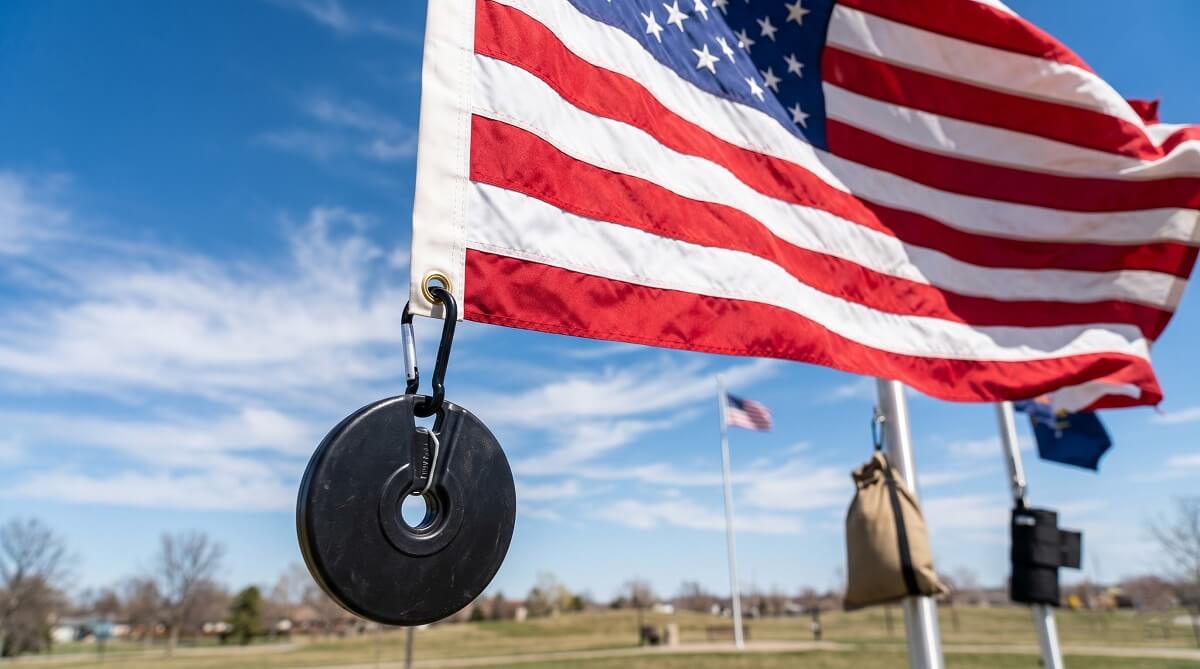
A flag weight is a small accessory — typically 1 to 1.5 lbs — that you attach to the bottom of your flag to keep it hanging straight and fully extended on gusty days. Without one, flags tend to bunch up, slide toward the top of the pole, or flap wildly without ever unfurling properly.
The type you need depends on your flagpole and flag setup. Ring-style weights hang from the bottom grommet hole. Clip-on canvas bags hook to the grommet loop. Adhesive rubber weights stick directly to the flag fabric. And if your flag keeps wrapping around the pole rather than just sliding up, a stainless steel flag tether (which includes a weight) is the better tool for the job.
Budget options start around $10–$15 on Amazon. Purpose-built, weather-resistant picks from flagpole specialists run $22–$35. For most homeowners flying a standard 3×5 flag on a 20 ft residential pole, a 1 to 1.5 lb weight is plenty. If you’re in a consistently gusty area or near the coast, look at tethers over simple clip-on weights.
Who Should (and Shouldn’t) Get a Flag Weight
✅ Get a flag weight if you:
- Own a standard residential flagpole (15–25 ft)
- Fly a 3×5 or 4×6 flag and it keeps sliding up or bunching on the pole
- Deal with moderate wind (generally under 30 mph)
- Want your flag fully visible from the street without fussing with it daily
❌ Skip the basic weight (use a tether instead) if:
- Your flag wraps completely around the pole in wind — a tether solves that; a simple bottom weight doesn’t
- You’re in a coastal or consistently gusty area with winds regularly above 30 mph
- You fly your flag at half staff on a telescoping pole (you’ll need a tether for that)
- You have a very large flag (5×8 or bigger) on a tall pole — a dedicated counterweight system may be more appropriate
What Does a Flag Weight Actually Do?
Flags on outdoor poles face two main problems in windy conditions. First, the wind can push the entire flag upward along the pole, leaving it bunched near the top where it can’t unfurl. Second, the flag fabric can twist and wrap around the pole itself — especially when wind shifts direction rapidly.
A flag ballast addresses the first problem by adding downward tension to the flag’s lower edge. Gravity pulls the weight down, which pulls the bottom of the flag down with it, keeping the fabric taut and visible.
A flag tether (a separate but related product) addresses the wrapping problem by keeping the flag body physically close to the pole, reducing how far it can rotate. Many tethers also include a small weight component, giving you both functions in one piece. If your flag wraps more than it slides, look at tethers — which we cover below.
Types of Flag Weights for Windy Days
There are four main types on the market. Each attaches differently and suits a slightly different setup.
Ring-Style / Grommet Weights
These are the most traditional design. A metal or plastic ring threads through the bottom grommet hole of the flag, and the bottom weight hangs below it. They’re purpose-built for standard residential flags with grommets, and they stay put reliably.
The Flagpole Solutions Flag Weight is a good example — it applies 1.5 lbs through a ring that hooks onto the grommet or flag ring, and it’s priced at $35.00 direct from the manufacturer. That’s on the higher end for a single weight, but it’s a purpose-built accessory from a dedicated flagpole company based in Minnesota.
Clip-On Canvas Weight Bags
Clip-on weights use a small hook or carabiner-style clip to attach to the bottom grommet loop. The weight itself is a sand-filled canvas bag — compact, soft, and quiet even when the flag moves around.
Vispronet makes a widely available version: a 2.4-inch canvas bag filled to 1 lb, available in single packs up to 25-packs on Amazon. These are solid for flags with standard grommets. Check current pricing on Amazon for the single-pack option.
Adhesive Stick-On Weights
If your flag doesn’t have grommets — or you just want a simpler installation — adhesive weights peel and stick directly to the flag fabric. The ADHERE-O version is transparent rubber, 8 pieces per pack, and weatherproof enough for outdoor use. You press them on firmly for about 10 seconds and they’re done.
These work for garden flags, banner-style flags, or any flag without grommet hardware. The tradeoff is durability: adhesive can weaken over time in extreme heat or UV exposure. Check current pricing and availability on Amazon.
Stainless Steel Flag Tethers with Weight
These combine two functions: the tether keeps the flag body close to the pole, and the attached weight adds downward tension at the bottom. It’s the most complete solution for flagpoles in exposed or high-wind locations.
The Service First Products Stainless Steel Flag Tether and Weight is currently priced at $21.97 (on sale from $29.99 regular), made from stainless steel with beads and a lead-free weight. It works with halyard (rope) systems on both telescoping and sectional poles. It’s also the tool you need if you want to fly a flag at half staff on a telescoping pole. Nine customer reviews, all 5 stars.
How Much Weight Does Your Flag Actually Need?
The right weight depends on your flag size, pole height, and wind exposure. As a general rule, a flag’s length should be roughly one-quarter the height of the flagpole — so your flag size and pole height are closely linked.
Here’s a practical starting point based on standard residential flagpole setups:
| Flag Size | Typical Pole Height | Recommended Weight | Notes |
|---|---|---|---|
| 2×3 ft | 6–10 ft (house mount) | 0.5–0.75 lb | Garden or decorative flags; adhesive style works well |
| 3×5 ft | 20 ft | 1–1.5 lbs | Most common residential setup; single clip-on or ring weight |
| 4×6 ft | 25 ft | 1.5–2 lbs | May need two weights or one heavier grommet weight |
| 5×8 ft | 30 ft | 2–3 lbs | Consider a tether+weight combo for better control |
| 6×10 ft and up | 35 ft+ | 3+ lbs or internal counterweight system | External clip weights may not be sufficient; consult installer |
In consistently gusty conditions, add approximately 0.5 lbs to the recommendation above. And if the flag wraps rather than slides, switch to a tether — more weight won’t fix a wrapping problem.
Per The Flagpole Store’s sizing guide, the standard ratio for American flags is one-quarter pole height equals flag length. That’s a useful starting point for sizing both your flag and the flag anchor you’ll need.
How to Attach a Flag Weight
The process is straightforward regardless of the style you choose. No tools required for any of these.
Ring or Clip-On Style
- Lower your flag or remove it from the pole completely
- Thread the ring or open the clip and attach it to the bottom grommet hole or loop
- Make sure the weight hangs freely below the flag with no obstructions
- Re-attach the flag to the halyard and raise it
Adhesive Style
- Lay the flag flat on a clean surface
- Peel the backing from the adhesive weight
- Press firmly onto the bottom hem of the flag for 10 seconds
- Let it cure for a few minutes before hanging
Tether + Weight Style
- Attach the tether cord to the flagpole at the appropriate point (typically near where the flag flies)
- Connect the other end of the tether to the flag’s lower grommet
- The attached weight hangs below, adding downward tension
- Raise the flag — it should fly close to the pole and stay extended
Flag Weight vs. Flag Tether: Quick Comparison
People often confuse these two products. They solve related but different problems.
| Feature | Flag Weight | Flag Tether |
|---|---|---|
| Primary purpose | Keep flag bottom pulled down and flag extended | Keep flag body close to pole; prevent wrapping |
| Stops sliding up pole | Yes | Partially |
| Stops wrapping around pole | Rarely | Yes |
| Works for half-staff display | No | Yes (telescoping poles) |
| Typical price range | $10–$35 | $20–$35 |
| Material options | Canvas, rubber, plastic, stainless | Stainless steel cord, beaded cord |
| Best for | Moderate wind; flag slides up but doesn’t wrap | Higher winds; coastal; flag wraps or twists |
If you’re in a typical suburban backyard with moderate seasonal winds, a standard clip-on or ring weight handles things well. If you’re on an open lot, near water, or the flag regularly coils around the pole, go with the tether.
Best Flag Weights for Windy Days — Our Picks
Best All-Around: Service First Products Stainless Steel Flag Tether and Weight
Price: $21.97 (on sale from $29.99 regular) at Service First Products
This one earns its spot at the top for two reasons: it’s stainless steel (won’t rust after seasons of outdoor exposure), and it does double duty as both a tether and a weight. That means it handles wrapping and sliding in one product. It works with rope halyard systems on both telescoping and sectional poles, and it’s the right tool if you ever need to fly at half staff on a telescoping pole. Nine reviews, all five stars. Lead-free weight included.
Best for: Most residential setups, especially telescoping poles or areas with inconsistent wind direction.
Best Budget Option: Clip-On Canvas Bags (Vispronet or Oudain)
Price: Check current pricing on Amazon — Vispronet 1-pack typically runs under $15; Oudain 2-pack also available
If your flag just slides up the pole in moderate wind and you want a simple fix, a 1 lb clip-on canvas bag from Vispronet or Oudain does the job. Clips to the bottom grommet in seconds, no tools. The canvas holds up reasonably well in rain. The Oudain 2-pack gives you two weights — useful if you want extra tension on a larger flag or one for a spare. One reviewer noted the weights didn’t stop wrapping on their pole, which is a reminder that clip-ons address sliding, not wrapping.
Best for: Standard 3×5 flags on a rope halyard pole in light to moderate wind.
Best for Flags Without Grommets: ADHERE-O Transparent Adhesive Weights
Price: Check current pricing on Amazon
Garden flags, custom-printed banners, and decorative flags often skip the grommet hardware entirely. ADHERE-O’s stick-on weights are the solution — transparent rubber squares with strong weather-resistant adhesive. Press them onto the bottom hem and they stay put through rain and sun. The 8-piece pack gives you plenty to work with across multiple flags. Adhesive longevity can vary in extreme heat, so check and replace seasonally if needed.
Best for: Garden flags, banner flags, decorative or custom-printed flags without grommets.
Best Dedicated Grommet Weight: Flagpole Solutions Flag Weight
Price: $35.00 at Flagpole Solutions
The most expensive option here, but it’s a purpose-built, no-compromise product from a dedicated flagpole company. The ring threads directly through the grommet hole and the 1.5 lb weight hangs securely below. If you bought a quality flagpole and want an accessory that matches that quality, this is it. No canvas bags, no adhesive — just a solid metal weight on a ring.
Best for: Quality residential flagpoles; buyers who want a permanent, no-fuss solution.
Frequently Asked Questions
Do flag weights damage flags?
Not if you use the right type. Grommet-ring weights hang from the existing hole, which is designed for hardware use. Clip-on weights apply gentle pressure to the grommet loop. Adhesive weights sit on the fabric surface — the main risk is pulling fabric fibers slightly when removing them. For high-quality flags, choose grommet-style over adhesive.
Will a flag weight work on a telescoping pole?
A basic clip-on weight can work if your flag has bottom grommets. However, a stainless steel tether (like the Service First model) is a better fit for telescoping poles — it connects the flag to the pole itself, preventing both wrapping and sliding, and works for half-staff display too.
How do I know if a flag weight is too heavy?
If the flag looks stiff, pulled straight down, and doesn’t wave naturally in a light breeze, the weight may be excessive. A properly weighted flag should hang with its lower edge taut while still flowing in the wind. For a standard 3×5 flag, 1 to 1.5 lbs is typically sufficient — going heavier than 2 lbs can stress the fabric and grommets over time.
Can I use a fishing sinker instead of buying a flag weight?
Yes, and many people do. A 1 lb fishing sinker with a clip or zip tie through the grommet hole works as a DIY flag weight. It’s not as clean-looking as a purpose-built product, but it’s functional. The main downside is that bare lead sinkers can corrode and stain the flag over time — wrap it in electrical tape or choose a coated sinker if you go this route.
Do flag weights work for garden flags?
Standard grommet-style weights don’t work for most garden flags, which typically hang from a sleeve rather than grommets. Adhesive weights (like ADHERE-O) are the right choice for garden or decorative flags — they stick directly to the fabric.
What’s the best way to stop my flag from wrapping around the pole?
A flag weight alone usually won’t stop wrapping — it only adds downward tension. For wrapping, you need either a flag tether (which keeps the flag body close to the pole) or anti-wrap spinning rings (rings that mount on the pole and let the flag pivot with wind direction). A stainless steel tether+weight combo addresses both problems simultaneously.
How do I fly a flag at half staff on a telescoping pole?
Telescoping poles don’t have a traditional halyard system, so you can’t just lower the flag to half-staff the standard way. A flag tether — attached to the pole at the halfway point — lets you position and hold the flag at that height. This is one of the key uses of the Service First Products tether kit.
Are flag weights weather-resistant?
Stainless steel tethers and weights are rust-resistant and built for long-term outdoor use. Canvas clip-on bags hold up in rain but can fade or soften over seasons. Rubber and plastic clip-on styles are generally UV- and water-resistant but may become brittle after several years. Adhesive weights are outdoor-rated but may need to be replaced seasonally in very hot or very cold climates.
Ready to pick one? Check current prices and availability on Amazon’s flag weight listings, or buy direct from Service First Products or Flagpole Solutions for specialty options.
